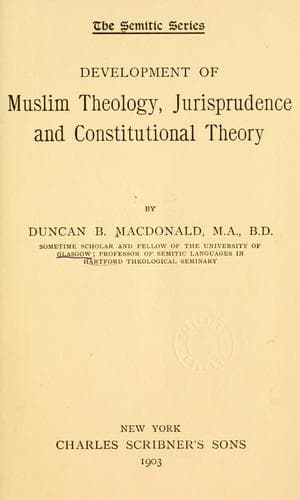
Development of Muslim Theology, Jurisprudence, and Constitutional TheoryMacDonald, Duncan Black
ReligionIslamic
Development of Muslim Theology, Jurisprudence, and Constitutional Theory
MacDonald, Duncan Black
Constitutional law (Islamic law); Islam -- Doctrines -- History; Islam and state -- History; Islamic law -- History
Muslim princes even in far-off India did
not feel quite safe upon their thrones unless they had been solemnly
invested by the Khalifa and given their fitting title. Those very rulers
in whose power the Khalifa’s life lay sought sanction from him for their
rule. At one time there seemed to be some hope that the fatal unity
of theocratical Islam would be broken and that a dualism with promise
of development through conflict—such as the rivalry between Pope and
Emperor which kept Europe alive and prevented both State and Church from
falling into decrepit decay—might grow up; that the Khalifa might become
a purely spiritual ruler with functions of his own, ruling with mutual
subordination and co-ordinate jurisdiction beside a temporal Sultan. The
Buwayhids were Shi‘ites and merely tolerated, for state reasons, the
impieties of the Sunnite Khalifas. But in 447 (A.D. 1055), Tughril Beg,
the Saljuq, entered Baghdad, was proclaimed Sultan of the Muslims and
freed the Khalifa from the Shi‘ite yoke. By 470, all western Asia, from
the borders of Afghanistan to those of Egypt and the Greek Empire, were
Saljuq. With the Saljuq Sultan as Emperor and the Khalifa as Pope, there
was a chance that the Muslim State might enter on a stage of healthy
growth through conflict. But that was not to be. Neither State nor
Church rose to the great opportunity and the experiment was finally and
forever cut off by the Mongol flood. When the next great Sultanate—that
of the Ottoman Turks—arose, it gathered into its hands the reins of the
Khalifate as well. This is what might have been in Islam, built on actual
history in Europe. The situation that did arise in Islam may become more
clear to us if we can imagine that in Europe the vast plans of Gregory
VII. had been carried out and the Pope had become the temporal as well as
the spiritual head of the Christian world. Such a situation would have
been similar to that in the world of Islam at its earliest time during
some few years under the dynasty of the Umayyads, when the one temporal
and spiritual sovereign ruled from Samarqand to Spain. Then we can
imagine how the vast fabric of such an imperial system broke down by its
own weight. Under conflicting claims of legitimacy, an anti-Pope arose
and the great schism began. Thereafter the process of disintegration was
still more rapid. Provinces rose in insurrection and dropped away from
each rival Pope. Kingdoms grew up and the sovereigns over them professed
themselves to be the lieutenants of the supreme Pontiff and sought
investiture from him. Last, the States of the Church itself—all that was
left to it—came under the rule of some one of these princes and the Pope
was, to all intents, a prisoner in his own palace. Yet the sovereignty
of the Khalifa was not simply a legal fiction, any more than that of the
Pope would have been in the parallel just sketched. The Muslim princes
thought it well to seek spiritual recognition from him, just as Napoleon
I.
Public-domain text, read in full here on John Shaqi.
Reviews
Reviews
No reviews yet
Be the first to share your thoughts on this work.
Join the Discussion
Join the discussion
Sign in to leave a comment or review.
Sign InorCreate an account