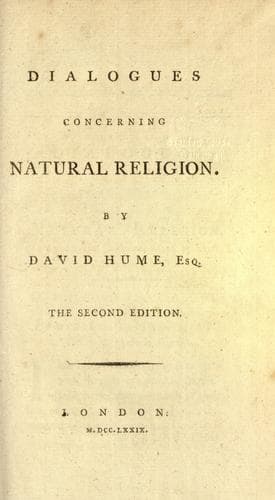
Natural theology -- Early works to 1800; Religion -- Early works to 1800
If every thing in the universe be conducted by general laws, and if
animals be rendered susceptible of pain, it scarcely seems possible but
some ill must arise in the various shocks of matter, and the various
concurrence and opposition of general laws; but this ill would be very
rare, were it not for the third circumstance, which I proposed to
mention, viz. the great frugality with which all powers and faculties are
distributed to every particular being. So well adjusted are the organs
and capacities of all animals, and so well fitted to their preservation,
that, as far as history or tradition reaches, there appears not to be any
single species which has yet been extinguished in the universe. Every
animal has the requisite endowments; but these endowments are bestowed
with so scrupulous an economy, that any considerable diminution must
entirely destroy the creature. Wherever one power is increased, there is
a proportional abatement in the others. Animals which excel in swiftness
are commonly defective in force. Those which possess both are either
imperfect in some of their senses, or are oppressed with the most craving
wants. The human species, whose chief excellency is reason and sagacity,
is of all others the most necessitous, and the most deficient in bodily
advantages; without clothes, without arms, without food, without lodging,
without any convenience of life, except what they owe to their own skill
and industry. In short, nature seems to have formed an exact calculation
of the necessities of her creatures; and, like a rigid master, has
afforded them little more powers or endowments than what are strictly
sufficient to supply those necessities. An indulgent parent would have
bestowed a large stock, in order to guard against accidents, and secure
the happiness and welfare of the creature in the most unfortunate
concurrence of circumstances. Every course of life would not have been so
surrounded with precipices, that the least departure from the true path,
by mistake or necessity, must involve us in misery and ruin. Some
reserve, some fund, would have been provided to ensure happiness; nor
would the powers and the necessities have been adjusted with so rigid an
economy. The Author of Nature is inconceivably powerful: his force is
supposed great, if not altogether inexhaustible: nor is there any reason,
as far as we can judge, to make him observe this strict frugality in his
dealings with his creatures. It would have been better, were his power
extremely limited, to have created fewer animals, and to have endowed
these with more faculties for their happiness and preservation. A builder
is never esteemed prudent, who undertakes a plan beyond what his stock
will enable him to finish.
Public-domain text, read in full here on John Shaqi.
Reviews
Reviews
No reviews yet
Be the first to share your thoughts on this work.
Elsewhere in the archive
Join the Discussion
Join the discussion
Sign in to leave a comment or review.
Sign InorCreate an account