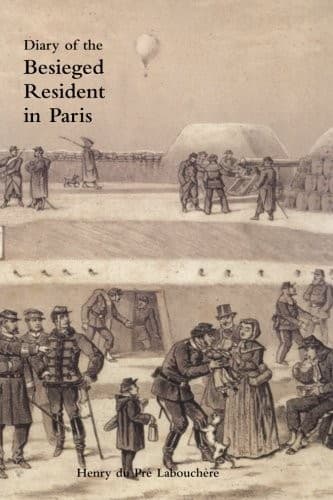
Diary of the Besieged Resident in ParisLabouchere, Henry Du Pré
History
Diary of the Besieged Resident in Paris
Labouchere, Henry Du Pré
Franco-Prussian War, 1870-1871; Paris (France) -- History -- Siege, 1870-1871 -- Personal narratives
The news of the fall of Strasburg and Toul was received by the
Government here this morning, and has just been made public. "In
falling," says M. Gambetta, "they cast a glance towards Paris to affirm
once more the unity and indivisibility of the Republic; and they leave
us as a legacy the duty to deliver them, the honour to revenge them."
The Boulevards were crowded, and everyone seemed as much astonished as
if they had never believed this double disaster to be possible. Many
refused to credit the news. _L'Electeur Libre_ proposes to meet the
emergency by sending "virile missionaries into the provinces to organise
a _levee en masse_, to drive from our territory the impious hordes which
are overrunning it." These missionaries would, I presume, go to their
posts in balloons. It never seems to occur to anyone here that the
authority of a Parisian dropping down from the clouds in a parachute in
any province would be contested. The right of Paris to rule France is a
dictum so unquestioned in the minds of the Parisians, that their
newspapers are now urging the Government to send new men to Tours to
oust those who were sent there before the commencement of the siege. It
strikes no one that the thirty-eight million of Frenchmen outside Paris
may be of opinion that the centralization of all power in the hands of
the most corrupt and frivolous capital in the universe has had its share
in reducing France to her present desperate condition, and may be
resolved to assert their claim to have a voice in the conduct of public
affairs. The Parisians regard all provincials as helots, whose sole
business it is to hear and to obey. If the result to France of her
disasters could be to free her at once from the domination of the
Emperor and of Paris, she would in the end be the gainer by them.
I hear that General Vinoy expresses himself very satisfied with the
soldierly bearing of the Mobiles who were under fire on Friday. It was
far better, he says, than he expected. He ascribes the failure of his
sortie to the forts having forewarned the Prussians by their heavy
firing between three and four o'clock in the morning. M. de Rohan,
"delegate of the democracy of England," has written a long letter to M.
Jules Favre informing him that a friend who has arrived from London (!)
has brought news of an immense meeting which has been held in favour of
France, and that this meeting represents the opinion of the whole of
England. M. Jules Favre, in his reply, expresses his sincere thanks "for
the sentiments which have been so nobly expressed in the name of the
English nation." The correspondence occupies two columns in the _Journal
Officiel_. M. de Rohan's residence in England is, I should imagine, in
the vicinity of Tooley-street.
_October 3rd._
The _Journal Officiel_ contains a decree ordering the statue of
Strasburg, on the Place de la Concorde, to be replaced by one in bronze.
No war news.
CHAPTER V.
_October 5th._
Public-domain text, read in full here on John Shaqi.
Reviews
Reviews
No reviews yet
Be the first to share your thoughts on this work.
Join the Discussion
Join the discussion
Sign in to leave a comment or review.
Sign InorCreate an account