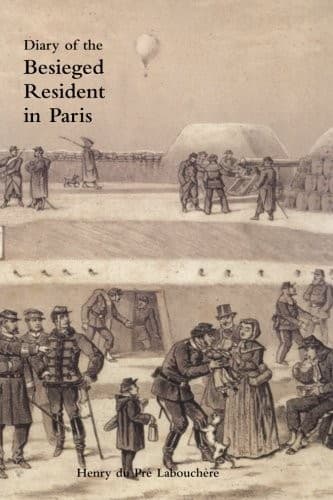
Diary of the Besieged Resident in ParisLabouchere, Henry Du Pré
History
Diary of the Besieged Resident in Paris
Labouchere, Henry Du Pré
Franco-Prussian War, 1870-1871; Paris (France) -- History -- Siege, 1870-1871 -- Personal narratives
Paris would hardly be recognised under its present aspect by those
citizens of the Far West who are in the habit of regarding it as a place
where good Americans go when they die. In the garden of the Tuileries,
where _bonnes_ used to flirt with guardsmen, there is an artillery camp.
The guns, the pickets of horses, the tents, the camp-fires, and the
soldiers in their shirt-sleeves, have a picturesque effect under the
great trees. On the Place de la Concorde from morning to evening there
is a mob discussing things in general, and watching the regiments as
they defile with their crowns before the statue of Strasburg. In the
morning the guns of the forts can be heard heavily booming; but the
sound has now lost its novelty, and no one pays more attention to it
than the miller to the wheel of his mill. In the Champs Elysees there
are no private carriages, and few persons sitting on the chairs. The
Palais de l'Industrie is the central ambulance; the Cirque de
l'Imperatrice a barrack. All the cafes chantants are closed. Some few
youthful votaries of pleasure still patronise the merry-go-rounds; but
the business cannot be a lucrative one. Along the quays by the river
side there are cavalry and infantry regiments under tentes d'abri. The
Champ de Mars is a camp. In most of the squares there are sheep and
oxen. On the outer Boulevards lines of huts have been built for the
Mobiles, and similar huts are being erected along the Rue des Remparts
for the Nationaux on duty. Everywhere there are squads of Nationaux,
some learning the goose-step, others practising skirmishing between the
carts and fiacres, others levelling their guns and snapping them off at
imaginary Prussians. The omnibuses are crowded; and I fear greatly that
their horses will be far from tender when we eat them. The cabbies,
once so haughty and insolent, are humble and conciliatory, for Brutus
and Scaevola have taught them manners, and usually pay their fares in
patriotic speeches. At the Arc de Triomphe, at the Trocadero, and at
Passy, near the Point du Jour, there are always crowds trying to see the
Prussians on the distant hills, and in the Avenue de l'Imperatrice (now
the Avenue Uhrich), there are always numerous admirers of Mont Valerien
gazing silently upon the object of their worship. In the Faubourg St.
Antoine workmen are lounging about doing nothing, and watching others
drilling. In the outer faubourgs much the same thing goes on, except
where barricades are being built. Round each of these there is always a
crowd of men and women, apparently expecting the enemy to assault them
every moment. At the different gates of the town there are companies of
Mobiles and National Guards, who sternly repel every civilian who seeks
to get through them. On an average of every ten minutes, no matter where
one is, one meets either a battalion of Nationaux or Mobiles, marching
somewhere. The asphalt of the boulevards, that sacred ground of dandies
and smart dresses, is deserted during the daytime.
Public-domain text, read in full here on John Shaqi.
Reviews
Reviews
No reviews yet
Be the first to share your thoughts on this work.
Elsewhere in the archive
Join the Discussion
Join the discussion
Sign in to leave a comment or review.
Sign InorCreate an account