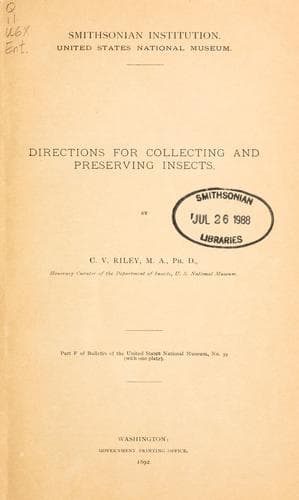
Directions for Collecting and Preserving InsectsRiley, Charles V. (Charles Valentine)
Science
Directions for Collecting and Preserving Insects
Riley, Charles V. (Charles Valentine)
Insects -- Collection and preservation
KILLING SPECIMENS.--Specimens not intended for rearing should be killed
immediately after capture unless for each specimen a separate vial or
box can be provided. If a number of miscellaneous insects are put in the
same vial the stronger specimens will, in a short time, crush or
otherwise injure the more delicate ones or the predaceous species will
devour any others they can master. But even where the specimens are
killed immediately the following rule should be observed: Do not put
large and small specimens in the same vial, but provide a larger bottle
for the larger specimens, and one, or still better, several, smaller
vials for the medium-sized and very small specimens. The importance of
this rule is recognized by all experienced collectors.
There are several methods of killing insects, each having its own
peculiar advantages and drawbacks.
_Alcohol._--The use of alcohol will, on the whole, prove the most
satisfactory method of killing Coleoptera, many Hemiptera, some
Neuroptera, and larvae of all sorts. Only the best quality of alcohol
should be used, but it should be diluted with from 30 to 40 per cent of
pure water, the greatest care being taken to keep the alcohol as clean
as possible. During the collecting a mass of debris and dirt is apt to
be thrown into the bottle, and when this is the case the alcohol should
be changed even during short excursions. At any rate, upon the return
from the excursion, the specimens should be at once taken from the
bottle and washed in pure alcohol in a shallow vessel. The larvae and
other material intended for permanent preservation in alcohol should be
transferred to suitable vials and the material to be mounted cleansed
with chloroform or acetic ether and then prepared for the cabinet. If it
is inconvenient or impossible to mount the Coleoptera, etc., soon after
the return from the excursion they should be washed, dried, and placed
in pill boxes between layers of soft paper, or they may be replaced in a
vial with pure alcohol. On longer collecting trips, lasting several days
or weeks, specimens will keep thus very well, provided they are not
shaken up, and this can be prevented by filling the empty space in the
vial with cotton or soft paper. If the bottle is a large one and
contains many large specimens the alcohol should be renewed three or
four times at intervals of eight or ten days; otherwise the specimens
are liable to decompose. Small and delicate specimens, if they are to
be kept in alcohol, should be treated with still greater care. Upon the
return from the excursion they should also be cleaned in pure alcohol
and placed in small vials into which a very few drops of alcohol, just
sufficient to keep the contents moist, are poured. The vial should be
corked as tightly as possible and the specimens will keep pretty well
for an indefinite time.
Public-domain text, read in full here on John Shaqi.
Reviews
Reviews
No reviews yet
Be the first to share your thoughts on this work.
Elsewhere in the archive
Join the Discussion
Join the discussion
Sign in to leave a comment or review.
Sign InorCreate an account