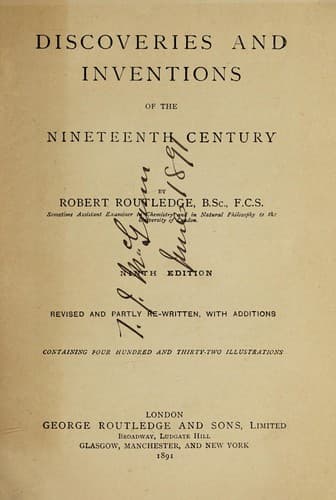
Discoveries and Inventions of the Nineteenth CenturyRoutledge, Robert
History
Discoveries and Inventions of the Nineteenth Century
Routledge, Robert
Inventions -- History -- 19th century
From the great rapidity with which the machinery of the locomotive
moves, the different parts require to be carefully balanced in order to
prevent dangerous oscillations. For example, the centrifugal force of
the massive cranks, etc., is balanced by inserting between the spokes of
the driving wheels certain counterpoises, the weights and positions of
which are finally adjusted by trial. The engine is suspended by chains
and set in motion, and a pencil attached to one corner of the frame
marks on a horizontal card the form of the oscillation, usually by an
oval figure. When the diameter of this figure is reduced to about 1/16
inch, the adjustment is considered complete.
The power of a locomotive, of course, depends on the pressure of the
steam and the size of the cylinder, &c.; but a very much lower limit
than is imposed by these conditions is set to the power of the engine to
draw loads by the adhesion between the driving wheels and the rails. By
the term “adhesion,” which is commonly used in this case, nothing more
is really meant than the friction between surfaces of iron. When the
resistance of the load drawn is greater than this friction, the wheels
turn round and slip on the rails without advancing. The adhesion depends
upon the pressure between the surfaces, and upon their condition. It is
greater in proportion as the weight supported by the driving-wheels is
greater, and when the rails are clean and dry it is equal to from 15 to
20 per cent. of that part of the weight of the engine which rests on the
driving-wheels; but when the rails are moist, or, as it is called,
“greasy,” the tractive power may be only 5 per cent. of the weight;
about one-tenth may be taken as an average. Suppose that 30 tons of the
weight of a locomotive are supported by the driving-wheels, that
locomotive could not be employed to drag a train of which the resistance
would cause a greater pull upon the coupling-links of the tender than
they would be subject to if they were used to suspend a weight of 3
tons. The number of pairs of wheels in a locomotive varies from two to
five; most commonly there are three pairs; and one, two, or all, are
driven by the engine, the wheels being coupled accordingly; very often
two pairs are coupled.
Public-domain text, read in full here on John Shaqi.
Reviews
Reviews
No reviews yet
Be the first to share your thoughts on this work.
Join the Discussion
Join the discussion
Sign in to leave a comment or review.
Sign InorCreate an account