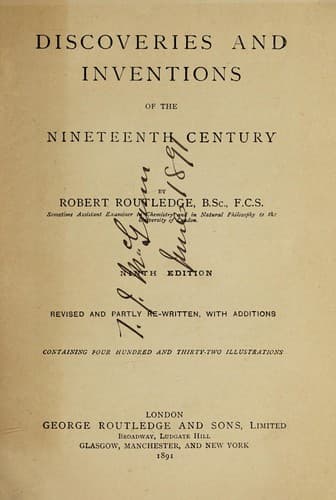
Discoveries and Inventions of the Nineteenth CenturyRoutledge, Robert
History
Discoveries and Inventions of the Nineteenth Century
Routledge, Robert
Inventions -- History -- 19th century
On Tuesday, 11th June, 1895, a race was started from Versailles to
Bordeaux and back, a distance of 727 miles or more for the double
journey. The first prize was the substantial sum of 40,000 francs
(£1,600), to which was attached the condition of the carriage seating
four persons, and other prizes were also to be awarded to various kinds
of automatic vehicles. No fewer than sixty-six vehicles were entered for
competition, and these were variously supplied with motive power from
steam, electricity, or petroleum spirit. The starting place was
Versailles at 12·9 p.m., and at 10·32 on Wednesday morning MM. Panhard &
Levassor’s petroleum carriage arrived at Bordeaux, whence, after a stop
of only four minutes, the return journey was begun, but shortly
afterward an accident caused a delay of one hour, but the carriage made
the whole distance at the average of 14·9 miles per hour. In this and
three other carriages belonging to the same firm, the propeller was the
Daimler motor. Though this carriage was the first to accomplish the trip
it received only the second prize, the condition of seating _four_
persons not having been complied with. The first prize fell to a
four-seated vehicle by Les Fils de Peugeot Frères, a firm who carried
off besides the third and fourth prizes. These carriages were also
driven by so-called petroleum motors. These motors are really gas
engines on the principle to be presently mentioned, but the gas is
produced by the vapourisation of a volatile constituent of petroleum
(benzoline). The Daimler motor is a compact combination of two cylinders
connected with a chamber containing the explosive mixture of gas and
air. The pistons perform their in and out strokes simultaneously, but
their working strokes alternately.
_PORTABLE ENGINES._
The application of steam power to agricultural operations has led to the
construction of engines specially adapted by their simplicity and
portability for the end in view. The movable agricultural engines have,
like the locomotives, a fire-box nearly surrounded by the water, and
horizontal tubes, and are set on wheels, so that they may be drawn by
horses from place to place. There is usually one cylinder placed
horizontally on the top of the boiler; and the piston-rod, working in
guides, is, as in the old locomotive, attached by a connecting-rod to
the crank of a shaft, which carries a fly-wheel, eccentrics, and pulleys
for belts to communicate the motion to the machines. Engines of this
kind are also much used by contractors, for hoisting stones, mixing
mortar, &c. These engines are made with endless diversities of details,
though in most such simplicity of arrangement is secured, that a
labourer of ordinary intelligence may, after a little instruction, be
trusted with the charge of the engine; while their economy of fuel,
efficiency, and cheapness are not exceeded in any other class of steam
engine.
Public-domain text, read in full here on John Shaqi.
Reviews
Reviews
No reviews yet
Be the first to share your thoughts on this work.
Elsewhere in the archive
Join the Discussion
Join the discussion
Sign in to leave a comment or review.
Sign InorCreate an account