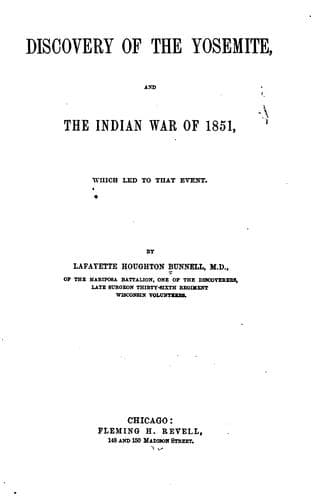
Discovery of the Yosemite, and the Indian War of 1851, Which Led to That EventBunnell, Lafayette Houghton
History
Discovery of the Yosemite, and the Indian War of 1851, Which Led to That Event
Bunnell, Lafayette Houghton
Indians of North America -- California; Pacific Coast Indians, Wars with, 1847-1865; Yosemite Valley (Calif.)
The temperature was mild and agreeable at our camp near the plain,
but we began to encounter storms of cold rain as we reached the more
elevated localities.
Major Savage being aware that rain on the foot-hills and plain at
that season of the year indicated snow higher up, sent forward scouts
to intercept such parties as might attempt to escape, but the storm
continued to rage with such violence as to render this order useless,
and we found the scouts awaiting us at the foot of a mountain known
as the Black Ridge. This ridge is a spur of the Sierra Nevada. It
separates the Mariposa, Chow-chilla, Fresno and San Joaquin rivers on
the south from the Merced on the north. While halting for a rest, and
sipping his coffee, Savage expressed an earnest desire to capture the
village he had ascertained to be located over the ridge on the south
fork of the Merced. He was of the opinion that if it could be reached
without their discovery of us, we should have no fighting to do there,
as that band would surrender at once rather than endanger their women
and children, who would be unable to escape through the snow. Toward
this village we therefore marched as rapidly as the nature of the
steep and snow-obstructed trail would permit us to travel. An Indian
that answered to the name of “Bob,” an _attaché_ of the Major, serving
as guide. Climbing up this steep black mountain, we soon reached the
region of snow, which at the summit, was fully four feet deep, though
the cold was not intense. By this time, night was upon us. The trail
led over the ridge at a point where its tabled summit was wooded with
a forest of pines, cedars and firs, so dense as almost to exclude the
light of the stars that now and then appeared struggling through the
gloom.
We laboriously followed our guide and file leader, but this trail
was so indistinctly seen in the darkness, that at intervals deep
mutterings would be heard from some drowsy rider who missed the beaten
path. As we commenced the descent of the ridge, the expressions became
more forcible than polite when some unlucky ones found themselves
floundering in the snow below the uncertain trail. If left to their own
sagacity, a horse or mule will follow its leader; but if a self-willed
rider insists upon his own judgment, the poor animal has not only
to suffer the extra fatigue incurred by a mis-step, but also the
punishment of the spur, and hear the explosive maledictions of the
master. The irritating responses of his comrades that “another fool has
been discovered,” was not then calculated to sooth the wrath that was
then let loose.
Public-domain text, read in full here on John Shaqi.
Reviews
Reviews
No reviews yet
Be the first to share your thoughts on this work.
Join the Discussion
Join the discussion
Sign in to leave a comment or review.
Sign InorCreate an account