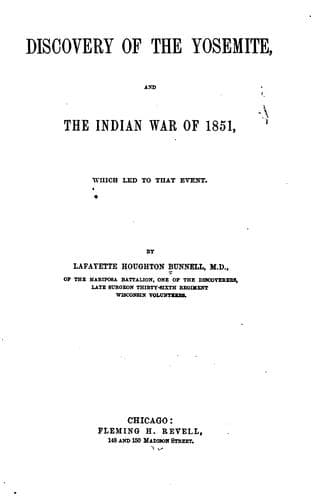
Discovery of the Yosemite, and the Indian War of 1851, Which Led to That Event — John Shaqi
Discovery of the Yosemite, and the Indian War of 1851, Which Led to That EventBunnell, Lafayette Houghton
History
Discovery of the Yosemite, and the Indian War of 1851, Which Led to That Event
Bunnell, Lafayette Houghton
Indians of North America -- California; Pacific Coast Indians, Wars with, 1847-1865; Yosemite Valley (Calif.)
The commissioners selected a reservation on the Fresno, near the
foot-hills, about eighteen or twenty miles from our camp, to which the
Indian tribes with whom treaties had been made were to be removed,
and at this locality the commissioners also established a camp, as
head-quarters.
The deliberative action on the part of the commissioners, who were very
desirous of having the Indians voluntarily come in to make treaties
with them, delayed any active co-operation on the part of our battalion
until the winter rains had fully set in. Our first extended expedition
to the mountains was made during the prevailing storms of the vernal
equinox, although detachments had previously made excursions into
the country bordering upon the Sierras. This region, like parts of
Virginia, proved impassable to a mounted force during the wet season,
and our operations were confined to a limited area.
It was at last decided that more extended operations were necessary
to bring in the mountain tribes. Although there was no longer unity
of action among them, they refused to leave their retreats, and had
become even suspicious of each other. The defeat of Jose Rey, and the
desertion of the tribes who had made, or had promised to make, treaties
with the commissioners, and had ceased from all hostile demonstrations,
had caused jealousies and discontent to divide even the most turbulent
bands. For the extended operations of the battalion among the
mountains, it was decided that Major Savage, with the companies of
Captains Boling and Dill, should make expeditions which would require
him to traverse the regions of the San Joaquin and Merced rivers.
Captain Kuy-ken-dall with his company were to be detached to operate
for the same purpose in the regions of the Kings and Kah-we-ah rivers.
The Indians captured were to be escorted to the commissioners’ camp on
the Fresno. Notwithstanding a storm was gathering, our preparations
were cheerfully made, and when the order to “form into line” was given,
it was obeyed with alacrity. No “bugle call” announced orders to us;
the “details” were made quietly, and we as quietly assembled. Promptly
as the word of command “mount,” was given, every saddle was filled.
With “forward march,” we naturally filed off into the order of march so
readily assumed by mounted frontiersmen while traveling on a trail.
We left our camp as quietly and as orderly as such an undisciplined
body could be expected to move, but Major Savage said that we must all
learn to be as still as Indians, or we would never find them.
This battalion was a body of hardy, resolute pioneers. Many of them had
seen service, and had fought their way against the Indians across the
plains; some had served in the war with Mexico and been under military
discipline.
Although ununiformed, they were well armed, and their similarities of
dress and accoutrements, gave them a general military appearance.
Public-domain text, read in full here on John Shaqi.
Reviews
Reviews
No reviews yet
Be the first to share your thoughts on this work.
Join the Discussion
Join the discussion
Sign in to leave a comment or review.
Sign InorCreate an account