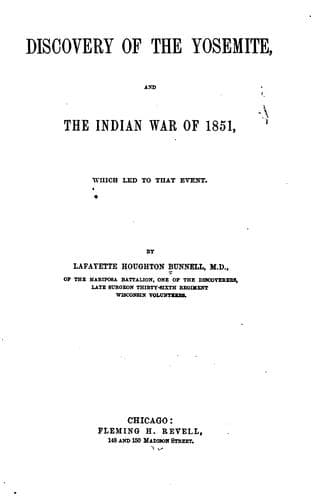
Discovery of the Yosemite, and the Indian War of 1851, Which Led to That EventBunnell, Lafayette Houghton
History
Discovery of the Yosemite, and the Indian War of 1851, Which Led to That Event
Bunnell, Lafayette Houghton
Indians of North America -- California; Pacific Coast Indians, Wars with, 1847-1865; Yosemite Valley (Calif.)
On the arrival of Captains Boling and Dill with their respective
companies, we were deployed into skirmish line, and advanced toward
the encampment without any effort at concealment. On discovering us
the Indians hurriedly ran to and fro, as if uncertain what course
to pursue. Seeing an unknown force approaching, they threw up their
hands in token of submission, crying out at the same time in Spanish,
“_Pace! pace!_” (peace! peace!) We were at once ordered to halt while
Major Savage went forward to arrange for the surrender. The Major was
at once recognized and cordially received by such of the band as he
desired to confer with officially. We found the village to be that of
Pon-wat-chee, a chief of the Noot-chü tribe, whose people had formerly
worked for Savage under direction of Cow-chit-ty, his brother, and
from whose tribe Savage had taken Ee-e-ke-no, one of his former wives.
The chief professed still to entertain feelings of friendship for
Savage, saying that he was now willing to obey his counsels. Savage, in
response, lost no time in preliminary affairs.
He at once told the chief the object of the expedition, and his
requirements. His terms were promptly agreed to, and before we had time
to examine the captives or their wigwams, they had commenced packing
their supplies and removing their property from their bark huts. This
done, the torch was applied by the Indians themselves, in token of
their sincerity in removing to the Reservations on the Fresno.
By the Major’s orders they had at once commenced their preparations for
removal to a rendezvous, which he had selected nearly opposite this
encampment, which was accessible to horses. This plateau was also the
location designated for our camp. This camp was afterwards used by an
employé at the agency, whose name was Bishop, and was known as Bishop’s
Camp. It is situated on an elevated table, on the right side of the
valley of the South Fork.
While the Indians were preparing for their transfer to the place
selected, our tired and hungry men began to feel the need of rest and
refreshments. We had traveled a much longer distance since the morning
before than had been estimated in expectation of a halt, and many of
the men had not tasted food since the day before.
John Hankin told Major Savage that if a roast dog could be procured,
he would esteem it an especial favor. Bob McKee thought this a capital
time to learn to eat acorn bread, but after trying some set before him
by “a young and accomplished squaw,” as the Major cynically termed
her, concluded he was not yet hungry enough for its enjoyment.
Public-domain text, read in full here on John Shaqi.
Reviews
Reviews
No reviews yet
Be the first to share your thoughts on this work.
Join the Discussion
Join the discussion
Sign in to leave a comment or review.
Sign InorCreate an account