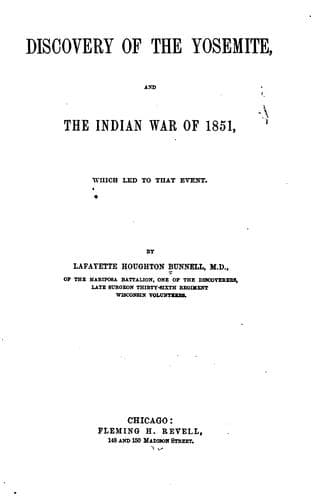
Discovery of the Yosemite, and the Indian War of 1851, Which Led to That EventBunnell, Lafayette Houghton
History
Discovery of the Yosemite, and the Indian War of 1851, Which Led to That Event
Bunnell, Lafayette Houghton
Indians of North America -- California; Pacific Coast Indians, Wars with, 1847-1865; Yosemite Valley (Calif.)
The Indians were at first somewhat alarmed at the noisy preparations,
and began to be fearful of their safety, but on learning the cause
of the excitement, they, too, became interested in the proceedings,
and expressed a desire to participate in the race. Two or three were
allowed to join in as proxies for the _“heavy ones”_ who concluded not
to run, though willing to pay the young Indians to represent them in
the race, provided they came out ahead. One young Indian did beat every
man, except Bob McKee, for whom he manifested great admiration. Many
anxious ones ran bare-footed in the snow. The Indian’s motions were
not impeded by any civilized garments; a modest waist cloth was all
they had on. In subsequent races, after a long rest, several of our
men demonstrated that their racing powers were superior to the fastest
of the Indian runners. Captain Boling’s racing scheme brought out the
strong points of the runners. Enough were distanced in both companies
to secure an ample camp-guard. The envious guard raised the point that
this method of detail was simply a proof of legs, not brains. It was
reported in camp that Captain Boling had kept a record of the speedy
ones which he had filed away for future use in cases where fleetness of
foot would be required for extra duties.
Preparations were made for an early start the next morning. The officer
to be left in charge of the camp was instructed to allow the Indians
all liberty consistent with _safety_, and to exercise no personal
restraint over them unless there should be an evident attempt to
leave in a body; when, of course, any movement of the kind was to
be defeated. The Major said: “I deem the presence of the women and
children a sufficient hostage for the peaceful conduct of the men,
but do not allow _any of them_ to enter our tents, or we may lose
possession.”
This last injunction was to guard against annoyance from vermin. The
_pediculi_ of the Indian race have an especial affinity for them. White
people have but little to fear from Indian vermin except the temporary
annoyance that is experienced from some species that infest animals and
birds. They do not find the transfer congenial, and soon disappear.
This fact may not be generally known, but I believe it to be a normal
arrangement for the exclusive _comfort_ of the Indian.
To me this is quite suggestive, when considered as evidence of a
diversity of origin of the races. I have been very particular in
my observations in this matter, and have compared my own with the
experiences of others, and have been led to the conclusion that each
separate race has parasites indigenous to that race, although the genus
may be common to each.
This reluctant adaptability of these “entomological inconveniences”
saved us from one of the curses of the ancient Egyptians, when contact
was unavoidable.
Public-domain text, read in full here on John Shaqi.
Reviews
Reviews
No reviews yet
Be the first to share your thoughts on this work.
Join the Discussion
Join the discussion
Sign in to leave a comment or review.
Sign InorCreate an account