Discovery of the Yosemite, and the Indian War of 1851, Which Led to That EventBunnell, Lafayette Houghton
History
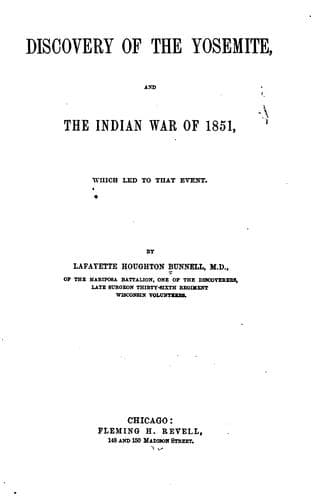
Discovery of the Yosemite, and the Indian War of 1851, Which Led to That Event
Bunnell, Lafayette Houghton
Indians of North America -- California; Pacific Coast Indians, Wars with, 1847-1865; Yosemite Valley (Calif.)
As they filed past us, the major took account of their number, which
was but seventy-two. As they reached our beaten trail, satisfaction
was variously expressed, by grunts from the men, by the low rippling
laughter from the squaws, and by the children clapping their hands in
glee at the sight. On being asked where the others of his band were,
the old Sachem said, “This is all of my people that are willing to
go with me to the plains. Many that have been with me are from other
tribes. They have taken wives from my band; all have gone with their
wives and children to the Tuolumne and to the Monos.” Savage told
Ten-ie-ya that he was telling him that which was not true. The Indians
could not cross the mountains in the deep snow, neither could they go
over the divide of the Tuolumne. That he knew they were still at his
village or in hiding places near it. Ten-ie-ya assured the major he was
telling him the truth, and in a very solemn manner declared that none
of his band had been left behind--that all had gone before his people
had left. His people had not started before because of the snow storm.
With a belief that but a small part of Ten-ie-ya’s band was with
this party, Major Savage decided to go on to the Indian village and
ascertain if any others could be found or traces of them discovered.
This decision was a satisfactory one and met with a hearty approval as
it was reported along the line.
This tribe had been estimated by Pon-wat-chee and Cow-chit-tee,
as numbering more than two hundred; as about that number usually
congregated when they met together to “_cache_” their acorns in the
valley, or for a grand annual hunt and drive of game; a custom which
secured an abundant supply for the feast that followed.
At other times they were scattered in bands on the sunny slopes of the
ridges, and in the mountain glens. Ten-ie-ya had been an unwilling
guide thus far, and Major Savage said to him: “You may return to camp
with your people, and I will take one of your young men with me. There
are but few of your people here. Your tribe is large. I am going to
your village to see your people, who will not come with you. They
_will_ come with me if I find them.”
Public-domain text, read in full here on John Shaqi.
Reviews
Reviews
No reviews yet
Be the first to share your thoughts on this work.
Elsewhere in the archive
Join the Discussion
Join the discussion
Sign in to leave a comment or review.
Sign InorCreate an account