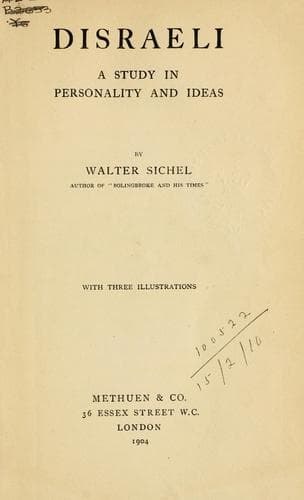
Disraeli: A Study in Personality and IdeasSichel, Walter
History
Disraeli: A Study in Personality and Ideas
Sichel, Walter
Disraeli, Benjamin, 1804-1881
“... Add to all these causes of suffering and discontent among the
workmen the apprehension of still greater evils, and the tyranny of
the ’butties,’ or middlemen, and it will with little difficulty be
felt that the public mind of this district was well prepared for the
excitement of the political agitator, especially if he were discreet
enough rather to descant on their physical sufferings and personal
injuries, than to attempt the propagation of abstract political
principles with which it was impossible for them to sympathise.... It
generally happens, however, that where a mere physical impulse urges
the people to insurrection, though it is often an influence of slow
growth and movement, the effects are more violent and sometimes more
obstinate than when they move under the blended authority of moral and
physical necessity, and mix up together the rights and the wants of
man.”
The pendant to the “rights” is the “_equality_” of man. Here, again,
nothing is more self-evident than man’s natural inequality. The whole
development of societies, which we call civilisation, is for the very
purpose of redressing or relieving these inequalities of occasion,
of equipment. By nature man, like the brute, starts without equality
and without rights. By his “mights” he has created these ideas, and
acquired something of their substance by his superior faculties, by
the spiritual energy which differentiates him. His “rights” spring
from the “law” which he has propagated. The political equality which
he has founded more than compensates him for the personal inequality
of his beginnings. The “personal equation,” indeed, would imply
the reversal both of his nature and of his craftsmanship; of all
conditions, moreover, compatible with variety of character and freedom
of action. It means, in fact, a denial of the existence of that natural
aristocracy which we find in every class and every order, and which
decides that everywhere the game of “follow my leader” must be played.
What is wanted is a real aristocracy which “claims great privileges for
great purposes.” What is always dangerous is the monopoly of action
by an aristocracy that shirks its duties, that plays at government,
that is dilettante in leadership or sybarite in life; or that, as
in the three decades preceding the French Revolution, revenges its
exclusion from influence by multiplying sinecures. It is such a class,
as contrasted with individuals--wherever found--of genuine capacities,
that so often evoked Disraeli’s irony, and has lately been satirised
by Mr. Barrie in a whimsy accentuating the natural inequality of man.
Speaking through the lips of “Egremont,” in that fine passage where he
cheers “Sybil”--the noble daughter of the people, disappointed by the
Charter and the Chartists--with a vista of the future, Disraeli says:
“The mind of England is the mind ever of the rising race. Trust me it
is with the People.... Predominant opinions are generally the opinions
Public-domain text, read in full here on John Shaqi.
Reviews
Reviews
No reviews yet
Be the first to share your thoughts on this work.
Join the Discussion
Join the discussion
Sign in to leave a comment or review.
Sign InorCreate an account