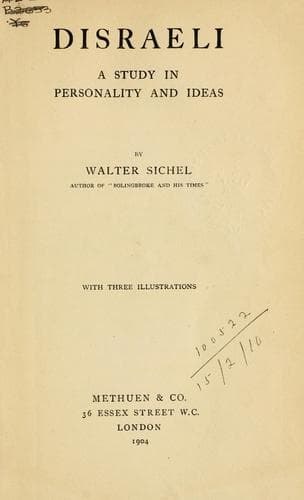
Disraeli: A Study in Personality and IdeasSichel, Walter
History
Disraeli: A Study in Personality and Ideas
Sichel, Walter
Disraeli, Benjamin, 1804-1881
Rousseau’s “Return” was a _sentimental_ one, for sentimentality
often attends materialism. The best side of Rousseau was that he
did undoubtedly leaven the irreverence of his generation with some
feeling for God. But Rousseau invented a past on which he founded his
hopefulness of sensibility--an inverted optimism. He cried aloud in
hysterics, “Man is born free; everywhere he is in chains.” To what
freedom was man born? The freedom of confusion. The order that he
evolves is the parent of his true freedom--the freedom to work and
serve, and to receive justice. The real “Rights of Man” are the rights
to justice that order creates. And if that order belies its name,
and injustice, disorder, masquerade as divine government, why then
Fifth-Monarchy men, French Revolutions, ruining cataclysm, witness
to the heavenly destinies, and order is born once more. Rousseau’s
sobs resembled those of the hero of French melodrama, who under stage
moonshine and stage misfortune, always ejaculates, “Ma mère!” His mere
emotion worked on nerves of sterner fibre and facts of harder quality.
Since Disraeli’s death, Nietzsche has propounded a physical “Return to
Nature,” which, however, excludes the humanitarian side of the French
“Equality.” He has sighed for a gigantic brood of antediluvian anarchs.
He has tried to make anarchy heroic. But a monster is not even a man,
still less a hero.
All such systems must fail, because, as Disraeli has finely said, “Man
is born to adore and to obey.” They contradict the spiritual facts
of our structure. For the true Right of Man is to lead wisely and be
led loyally in public affairs; neither to steal nor be stolen from
in private. These are what Carlyle terms his “correctly articulated
_mights_.” Leadership, loyalty, and social honesty belong to no “state
of nature” of which record or even guess is possible. And Disraeli
agreed with Carlyle when the latter wrote, after the former had in
effect said the same: “... ‘Supply and demand’ we will honour also; and
yet how many ‘demands’ are there, entirely indispensable, which have to
go elsewhere than to the shops!”
But Nietzsche’s theories are luckily untranslatable into action, and
inconsistent with any form of the “state.” Rousseau’s theories, on
the other hand, are the more dangerous because they are feasible. The
“Rights of Man” is a doctrine absolutely at issue with the “Rights of
Nations.” The abstract notion of universal “rights” is also at variance
with the pressing impulses of physical “wants.” Low wages and long
hours are not redressed by the apparatus of ballot-boxes or the cant
of independence. Physical needs due to economical causes, which can be
modified only by the earnest statesmanship of leaders rising to their
responsibilities, are not to be dismissed by the vague generalities of
“moral force.” This aspect is powerfully emphasised in _Sybil_.
Public-domain text, read in full here on John Shaqi.
Reviews
Reviews
No reviews yet
Be the first to share your thoughts on this work.
Join the Discussion
Join the discussion
Sign in to leave a comment or review.
Sign InorCreate an account