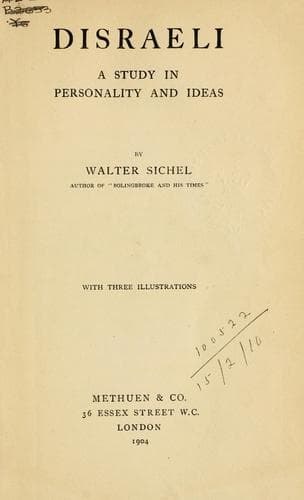
Disraeli: A Study in Personality and IdeasSichel, Walter
History
Disraeli: A Study in Personality and Ideas
Sichel, Walter
Disraeli, Benjamin, 1804-1881
“Natural” equality means “physical” equality, which was the true gist
of the many cries of the French Revolution. But its hurricane swept
away classes and privilege alone; the “equality” it created, that is
to say, was social and civil. Of civil “equality” Disraeli was always
the spokesman; for in England, civil equality means abolition of
monopolies. Privilege, as the ennobling boon of merit, stands open to
all, and the limits of the political orders or social classes to which
it is attached, are corrected by the wide freedom of public opinion
and discussion. “I hold that civil equality,” said Disraeli at Glasgow
in 1873, “the equality of all subjects before the law, and a law which
recognises the personal rights of all subjects, is the only foundation
of a perfect commonwealth.” His most striking utterances in _The Press_
from 1853 to 1859, and this Glasgow address, are perhaps his most
notable commentaries on this theme.
These are no mere subtleties. “Physical equality” has exercised a
very practical bearing on the doctrines of the Manchester School and
their relations to Sir Robert Peel’s double reform, above all to
those interests of Labour which both affected. I shall show this in
my next chapter.[53] Suffice it now to say that Disraeli descried
that in adopting the “Right to physical happiness” doctrine of
Manchester, at the very moment when he unshackled commerce and undid
the Corn Laws, Peel had adopted a principle which logically demands an
“unlimited employment of labour”--a thing inconsistent at once with his
restriction of Labour by removing the restraints on competition, and,
as Disraeli thought, with the very existence of states and of nations.
Peel thus became unconsciously _cosmopolitan_, at the very juncture
when he settled commerce and unsettled labour--
“The leading principle of this new school,” explained Disraeli,
treating of “equality” in 1873, “is that there is no happiness which
is not material, and that every living being has a right to share in
that physical welfare. The first obstacle to their purpose is found in
the rights of private property. Therefore these must be abolished. But
the social system must be established on some principle, and therefore
for the rights of property they would _substitute_ the rights of
Labour. Now these cannot fully be enjoyed, _if there be any limit to
employment. The great limit to employment, to the rights of Labour, and
to the physical and material equality of man is found in the division
of the world into states and nations._ Thus, as civil equality would
abolish privilege, social equality would destroy classes, so material
and physical equality strikes at the principle of patriotism, and is
prepared to abrogate countries.”
It was just this perception that enabled Disraeli nearly thirty years
earlier to predict--as we shall see--so much that has come and is
coming to pass.
Public-domain text, read in full here on John Shaqi.
Reviews
Reviews
No reviews yet
Be the first to share your thoughts on this work.
Join the Discussion
Join the discussion
Sign in to leave a comment or review.
Sign InorCreate an account