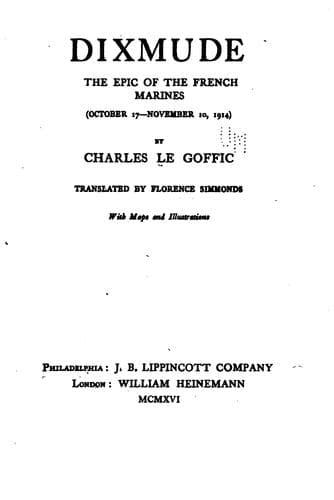
Dixmude: The epic of the French marines (October 17-November 10, 1914) — John Shaqi
Dixmude: The epic of the French marines (October 17-November 10, 1914)Le Goffic, Charles
History
Dixmude: The epic of the French marines (October 17-November 10, 1914)
Le Goffic, Charles
France. Marine. Brigade des fusiliers marins; World War, 1914-1918 -- Campaigns -- Belgium; Yser, Battle of the, Belgium, 1914
[36] Cf. Dr. Caradec, _op. cit._, also the note-book and letters of
Second-Lieutenant Gautier: "11 o'clock, the church on fire.... Sailors
are queer creatures. Yesterday, while the church was being bombarded
they exclaimed: 'Oh, the brutes! I wish I could get hold of one of them
and break his jaw!' This morning we took a wounded prisoner. There was
not a word of hatred, not an insult, as he passed. Two sailors were
helping him along. He said: 'Good-day. War is a terrible thing.' And our
men answered. They are more French than they think."
[37] "At first the big shells give one a very unpleasant sensation, but
one gets used to them, and learns to guess from the whistling noise they
make where they are likely to fall." (Second-Lieutenant Gautier's
note-book.)
[38] "The cattle are running about on all the roads and in all the
fields. No one attends to them." (Letter of the Marine E. T.) See also
below, De Nanteuil.
[39] Cf. Dr. Caradec, _op. cit._
[40] The note which furnishes this information as to the heroic conduct
of Lieutenant Cayrol adds: "Received a bullet in the middle of his
forehead. Brought into the dressing-station by his men, where he gave an
account of the incident and of the bravery of his men. He would not
consent to be removed until he had been assured that his machine-guns
were saved. Has come back to the front."
[41] Second-Lieutenant Gautier's note-book has the following under date
of October 22: "Cannonade still lively. One of our convoys blown to
pieces." The incident took place the day before, and is evidently
identical with that mentioned by Second-Lieutenant X. under date of
October 21: "Intensive shelling, a good deal of damage. De Mons and
Demarquay, naval lieutenants, wounded. The church on fire. In the
afternoon a German airship spotted an important convoy (provisions,
ambulances, munitions, etc.) on the road from Caeskerke to Oudecappelle.
The convoy was shelled."
[42] _Courrier de l'Armée Belge._ The pressure, says this official
_communiqué_, was very strong, had been very strong ever since the 20th.
On that day "a furious bombardment by guns of every calibre had been
kept up upon the Belgian lines. A farm situated in the front of the 2nd
Division was taken by the Germans, retaken by the Belgians, and again
lost." On the 21st a German attack upon Schoorbakke, combined with an
attack upon Dixmude, failed signally. But the Belgians were becoming
worn out.
[43] R. Kimley (_op. cit._), quoting Lieutenant Hébert, offers another
and perhaps a more acceptable explanation. In their dark blue overcoats
and their caps with red pompons, the sailors looked strange to the
Germans, who took them for _francs-tireurs_. The terror they inspired
was aggravated by this idea.
[44] The Abbés Le Helloco and Pouchard. We have spoken more than once of
the former, a man of great intelligence and of a self-abnegation
carried, in the words of Saint Augustine, _usque ad contemptum sui_. His
_confrère_ was equally devoted.
Public-domain text, read in full here on John Shaqi.
Reviews
Reviews
No reviews yet
Be the first to share your thoughts on this work.
Join the Discussion
Join the discussion
Sign in to leave a comment or review.
Sign InorCreate an account