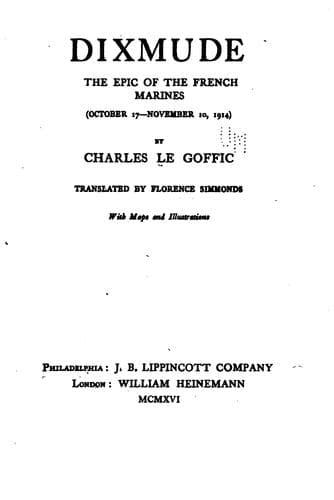
Dixmude: The epic of the French marines (October 17-November 10, 1914)Le Goffic, Charles
History
Dixmude: The epic of the French marines (October 17-November 10, 1914)
Le Goffic, Charles
France. Marine. Brigade des fusiliers marins; World War, 1914-1918 -- Campaigns -- Belgium; Yser, Battle of the, Belgium, 1914
the whole _schoore_ with its meshes. Slily, noiselessly, unceasingly, it
will rise on a soil already saturated like a sponge and incapable of
absorbing another drop of water. All that falls there, whether it come
from the sky in the form of rain, or from the hills of Cassel in the
form of torrents, will remain on the surface. There is no way of
checking the inundation as long as the flood-gates are not raised. He
who holds Nieuport holds the entire district by means of its locks. This
explains the persistence of the Germans in their attempts to capture it.
Fortunately, these attempts were somewhat belated; they tried a surprise
by the dunes of Lombaertzide and Middelkerke, which might perhaps have
succeeded but for the timely co-operation of the Anglo-French fleet with
the Belgian troops: the German attack was driven back by the fire of the
monitors, and failed to carry the locks of Nieuport. The inundation
continued. When its last meshes were woven and all its web complete, it
was to spread in a semicircle on a zone of 30 kilometres, and this
immense artificial lagoon, from four to five kilometres wide and from
three to four feet deep, in which light squadrons and batteries might
have engaged if hard pressed, but for the abrupt depressions of the
_watergands_ and collecting canals, forming invisible traps at every
step, was to constitute the most impregnable defensive front, a liquid
barrier defying all attacks. Dixmude, at the extremity of this lagoon,
in the blind alley here formed by the Yser, the Handzaeme Canal, and the
railway embankment, might aptly be compared to Quiberon; like Quiberon,
it would be, were its bridges destroyed, a sort of thin, low peninsula;
but it is a Flemish Quiberon anchored upon a motionless sea, without
waves and without tides, studded with tree-tops and telegraph poles, and
bearing on its dead waters the drifting corpses of soldiers and animals,
pointed helmets, empty cartridge-cases and food-tins.
IX. THE MURDER OF COMMANDER JEANNIOT
On October 25 we had not yet received any help from the inundation. Our
troops were in dire need of rest, and the enemy was tightening his grip
along the entire front. New reinforcements were coming up to fill the
gaps in his ranks; our scouts warned us that fresh troops were marching
upon Dixmude by the three roads of Eessen, Beerst, and Woumen.[46] We
had to expect a big affair the next day, if not that very night. It came
off that night.
Public-domain text, read in full here on John Shaqi.
Reviews
Reviews
No reviews yet
Be the first to share your thoughts on this work.
Join the Discussion
Join the discussion
Sign in to leave a comment or review.
Sign InorCreate an account