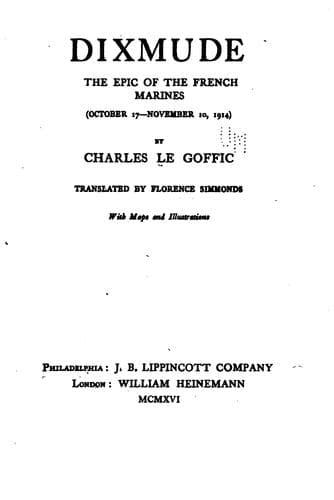
Dixmude: The epic of the French marines (October 17-November 10, 1914)Le Goffic, Charles
History
Dixmude: The epic of the French marines (October 17-November 10, 1914)
Le Goffic, Charles
France. Marine. Brigade des fusiliers marins; World War, 1914-1918 -- Campaigns -- Belgium; Yser, Battle of the, Belgium, 1914
It was raining the whole time. Weary of wading through the mud, the
officers stopped behind a hedge to hold a council. A pale light began to
pierce the mist; day was dawning, and they could no longer hope to
regain the German lines in a body. Prudence dictated that they should
disperse until nightfall. But what was to be done with the prisoners?
The majority voted that they should be put to death. The Belgian doctors
protested. Commander Jeanniot, who took no part in the debate, was
talking calmly to Quartermaster Bonnet. At a sign from their leader the
Boches knelt and opened fire upon the prisoners. The Commander fell, and
as he was still breathing, they finished him off with their bayonets.
The only survivors were the Belgian doctors, who had been spared, and
Quartermaster Bonnet, who had only been hit in the shoulder. It was at
this moment that the marauders were discovered. One section charged them
forthwith; another fell back to cut off their retreat. What happened
afterwards? Some accounts declare that the German officers learned what
it costs to murder prisoners, and that our men despatched the dogs there
and then; but the truth is, that, in spite of the general desire to
avenge Commander Jeanniot, the whole band was taken prisoner and brought
before the Admiral, who had only the three most prominent rascals of the
gang executed."
Another very interesting account of this episode has been communicated
to us by M. Charles Thomas Couture, chauffeur to Commander Varney.
AN UNPUBLISHED ACCOUNT OF THE MURDER OF COMMANDER JEANNIOT.
DIXMUDE, _Monday, October 26, 1914_.
Yesterday we were informed that a certain number of Germans,
slipping between the trenches, had managed to get into Dixmude.
Search was made in the houses and cellars, and we collected a few
prisoners.
This incident caused us some uneasiness, and as the bombardment,
which generally ceased at night, continued persistently, I
hesitated to go to bed. Shells were bursting quite close to our
inn, the front of which was peppered with bullets. Fortunately, the
shells were shrapnel, annoying rather than deadly, and as I was
very tired, I made up my mind to get a sleep about 10 o'clock. But
I lay down fully dressed and armed; I did not even lay aside my
revolver.
One after the other the inhabitants of the inn followed my example.
There were four of us: Commander Varney, Captain Monnot, Lieutenant
Bonneau, and myself. Dr. Duguet and Abbé Le Helloco, who generally
shared our straw, were detained at the ambulance by some severe
cases, and were not expected to come in before 1 o'clock in the
morning. By this time all was quiet, and the bombardment had
ceased.
Public-domain text, read in full here on John Shaqi.
Reviews
Reviews
No reviews yet
Be the first to share your thoughts on this work.
Join the Discussion
Join the discussion
Sign in to leave a comment or review.
Sign InorCreate an account