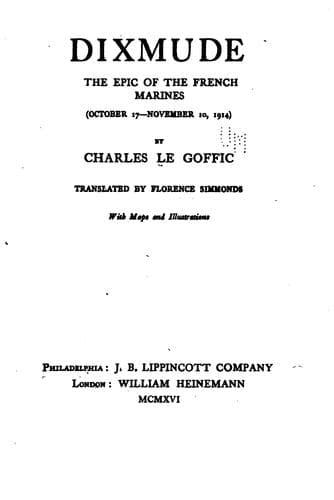
Dixmude: The epic of the French marines (October 17-November 10, 1914)Le Goffic, Charles
History
Dixmude: The epic of the French marines (October 17-November 10, 1914)
Le Goffic, Charles
France. Marine. Brigade des fusiliers marins; World War, 1914-1918 -- Campaigns -- Belgium; Yser, Battle of the, Belgium, 1914
And that same evening of October 26 this trench--or another--was again
attacked, and was only saved for us by a prodigy of heroism. The enemy
had advanced to within a few yards, and charged, shouting "Hurrah!" Our
machine-guns were very dirty and would not work.[54] But Lieutenant
Martin des Pallières was in command of the section. It was holding the
road to Woumen, between the wall of the cemetery and a trench dug on the
other side in a beetroot field. Des Pallières sprang upon the parapet.
"Boys," he cried, "we must receive these gentry with cold steel. Fix
bayonets!"
And when one of the Marines, a Parisian, who had charged too vigorously,
lamented the loss of his "hat-pin" (his bayonet), which he had left in a
German hide, Des Pallières replied: "Do as I do; charge with your
head."[55] The next day he was killed by a shell.
Meanwhile the brigade had passed under the command of General Grossetti,
who had undertaken the defence of the line of the Yser as far as, and
inclusive of, Dixmude (detachment of the army of Belgium under General
d'Urbal). The day of the 27th passed without an attack in force; the
enemy merely bombarded us. He gave us time to breathe the following
night and morning till 9 a.m. Then the hurly-burly began again. An
officer of the Naval Reserve who received his baptism of fire that day,
Lieutenant Alfred de la Barre de Nanteuil, grandson of General Le Flô,
wrote to his family that he had been specially favoured. "It was a fine
christening, plenty of sweetmeats, the whole show, bullets, shrapnel,
and, above all, the famous 'saucepans' (_marmites_). Chance treated me
well." In his section alone there were four killed, twelve wounded, and
eleven missing. This was the prelude to a sudden attack, directed
against the trenches in the cemetery, to which the enemy paid particular
attention. But we knew this, and had put our steadiest troops there. The
attack was again repulsed, thanks mainly to the firmness of the first
musketry instructor, Le Breton, who had already been wounded on the
24th, and who took command of the company when all the officers had been
put out of action.[56]
Public-domain text, read in full here on John Shaqi.
Reviews
Reviews
No reviews yet
Be the first to share your thoughts on this work.
Elsewhere in the archive
Join the Discussion
Join the discussion
Sign in to leave a comment or review.
Sign InorCreate an account