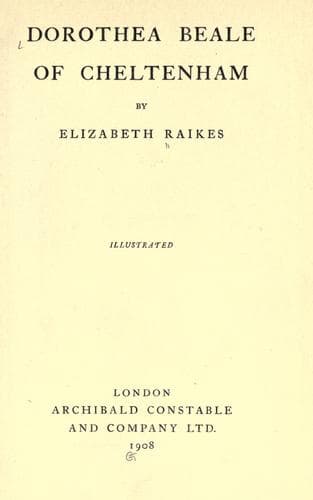
Beale, Dorothea, 1831-1906; Cheltenham Ladies' College -- History; Teachers -- England -- Biography
of the house of faith were yet secure, and thereon love rebuilt.
And so it may be truly said that the framework of her personal religion
was in age what it had been in youth. She had her own distinctly outlined
path to which she had been guided early by such friends as her father
and Mr. Mackenzie. This has been sometimes lost sight of, possibly owing
to her deep sympathy and interest in matters of doubt and difficulty.
When any of her children turned to her in distress of this nature, she
felt, more than at any other time, the yearning of a mother’s heart, and
was fearful of saying any word or even of showing any opinion of her own
which might alarm or seal up confidence. Hence people of widely different
views wished to claim her as of their own way of thinking when often
she was not. She did not think it of paramount importance when speaking
to the unorthodox, or even to the agnostic, to state her own beliefs
precisely. She did not seek to proselytise but to help, to remove, as
far as power was given her, all hindrances to the light, to persuade
those who were in darkness still to obey. But she knew that she could not
make any _see_; she recognised faith as the gift of God.
Miles Beale was a Churchman of the type known best by its nickname ‘High
and Dry.’ His daughters were still quite young when they found this
was a school to which not all the world belonged, and they began to
appreciate religious differences. They heard, between St. Helen’s and St.
Bartholomew’s, preachers of varying shades of thought. Mr. Mackenzie was
succeeded at St. Helen’s by an incumbent of evangelical views. Some of
Mr. Denton’s curates at St. Bartholomew’s went over to Rome; one became
Father Ignatius.
Dorothea was only sixteen when her father wrote to her on the subject of
the Hampden-Gorham dispute, as of a matter she well understood and found
interesting. And this recalls the fact that religious controversy of
that day raged specially round the question of Baptismal Regeneration.
A letter written to the Council of the Ladies’ College after her
appointment[28] shows how clearly and concisely, and without reference
to books, Miss Beale could state her opinions. It deals with her views
of the Sacraments, marking her religious position at the time and
indeed to the end;—it was for her Prayer-book that she asked in the one
clear moment of the last unconsciousness. This letter contains a bare,
unemotional statement of belief, to which may well be added this: that
while she held firmly the doctrine of ‘Two only, as generally necessary
to salvation,’ the life of grace through the Sacraments was the power
by which she lived. She recognised herself as fortunate in her special
heritage of Christian thought, writing of it thus:—
Public-domain text, read in full here on John Shaqi.
Reviews
Reviews
No reviews yet
Be the first to share your thoughts on this work.
Elsewhere in the archive
Join the Discussion
Join the discussion
Sign in to leave a comment or review.
Sign InorCreate an account