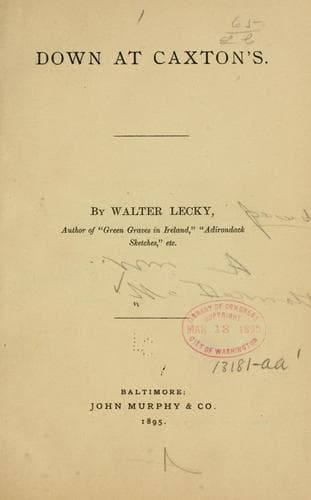
American literature -- 19th century -- History and criticism; American literature -- Catholic authors -- History and criticism
Rude, “they will endure; if not, all the laudation in the world would
not save them from oblivion.” The same may well be written of Catholic
literature. Whether for children or grown-up men or women, as a
Catholic critic, whose only aim has been to gain an audience for my
fellow Catholic writers whose works can bear a favorable comparison
with the best contemporary thought, I ask that the best shall be
given, and that given, it shall be joyfully received; that trash shall
not fill the book-cases, lie on the parlor-tables, be puffed in our
weeklies, and genius and sacrifice be forgotten. I ask that the works
of Stoddard, Johnston, Egan, Roche, Azarias, Lathrop, Tabb, Miss
Repplier, Guiney, Katherine Conway, Mrs. Blake, find a welcome in each
Catholic household, and that the Catholic press make their delightful
personalities known to our rising generation. Of their best they have
given. Shall they die before we acknowledge it?
AGNES REPPLIER.
A friend of mine, a dweller in the city, a lover of red bricks, one to
whom the sound of the dray-cart merrily grinding on the pavement is
sweeter music than a burst of woodland song, has tardily conceded that
the Adirondacks, on a summer day, is pleasant. I value his testimony
and record it with pleasure. Let us be thankful for small favors when
cynics are the donors. For me these woods, lakes and crystal streams
hold an indescribable charm. They are the true abode of man. Here is
liberty, while the city is but a cage, with its thousands uttering the
plaintive cry of Sterne’s prisoned starling, “I cannot get out.” For
the hum of wheels we have the songs of birds, the music of waterfalls,
the purr of mountain brooks and the harmonies of the winds playing
through the thousand different species of trees, each one differing in
melody, but combining in one grand symphony. Orchestras are muffled
music when compared to nature’s lute. The pipes of Pan is but a poet’s
struggle to embody in speech such a symphony. For the city’s smells,
that not even a Ruskin could paint, albeit they are far from elusive,
we have the mountain air that has dallied with the streams and stolen
the fragrance of a thousand clover fields. Every man to his taste.
There is no disputing of this. Lamb loved bricks and Wordsworth such
scenes as ours; yet, Lamb would be as sadly missed from our libraries
as Wordsworth. Swing my hammock in the shade of yonder pines, good
Patsy. A robin is piping his sweetest notes to his brooding spouse,
the Salmon river runs at my feet, biting the sandy shore, laughing
loud when a saucy stone falls in its current. From over the hills
comes the scent of new-mown hay; bless me! this is pleasant. To add
to this enjoyment you have brought a book—something bright, you tell
me. I’ll soon see. And gliding into my hammock, I said my first good
morning to Agnes Repplier. It was a breezy good morning, one of those
where the hand unconsciously goes out as much as to say: Old fellow,
Public-domain text, read in full here on John Shaqi.
Reviews
Reviews
No reviews yet
Be the first to share your thoughts on this work.
Join the Discussion
Join the discussion
Sign in to leave a comment or review.
Sign InorCreate an account