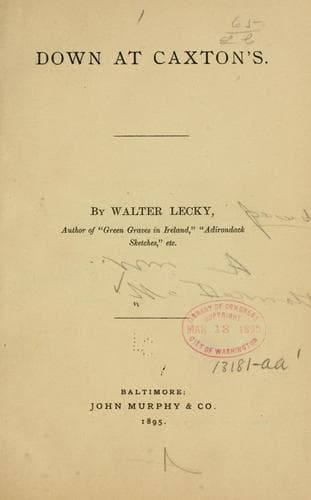
American literature -- 19th century -- History and criticism; American literature -- Catholic authors -- History and criticism
How delightful to watch this critic armed _cap-a-pie_, demolishing
some fad, that has masqueraded for years as genuine literature. Is
it little Lord Fauntleroy, a character sloppy, inane, impossible to
real life, yet hugged to the heart by the commonplace. Miss Repplier
keenly surveys her ground, as an artist would the statue of his rival,
notes the foibles, cant, false poses, and crazy-quilt jargon used to
deck pet characters. Experience has taught her that you cannot combat
seriously the commonplace. “The statesman or the poet,” says Dudley
Warner, “who launches out unmindful of this, will be likely to come to
grief in his generation.” Sly humor, pungent sarcasm, are the weapons
effectively used. The little Lord is unrobed, and the life that seemed
so full of charity and virtue, becomes but a mixture of hypocrisy and
snobbery. Yet, if some of our critics could, “all the dear old nursery
favorites must be banished from our midst, and the rising generation
of prigs must be nourished exclusively on Little Lord Fauntleroy, and
other carefully selected specimens of milk and water diet.” The dear
land of romance, in its most charming phase, that phase represented
by Red Riding Hood, Ali Baba, Blue Beard, and the other heroes of our
nurseryhood must be eliminated, for children are no longer children,
in the old sense of believing “in such stuff” without questioning.
American children, at any rate, are too sensitively organized to
endure the unredeemed ferocity of the old fairy stories, we are told,
and it is added, “no mother nowadays tells them in their unmitigated
brutality.” These are the empty sayings of the realists, who would have
every child break its dolls to analyze the sawdust. The most casual
observer of American homes knows that our children will not be fed on
such stuff as realists are able to give, but will turn wistfully back
to those brave old tales which are their inheritance from a splendid
past, and of which no hand shall rob them. As Miss Repplier so well
puts it, “we could not banish Blue Beard if we would. He is as immortal
as Hamlet, and when hundreds of years shall have passed over this
uncomfortably enlightened world, the children of the future—who,
thank Heaven, can never, with all our efforts, be born grown-up—will
still tremble at the blood-stained key, and rejoice when the big
brave brothers come galloping up the road.” Ferocity, brutality, if
you will, may couch on every page, but this is much better than the
sugared nothingness of Sunday school tales, and beats all hollow, as
the expression goes, the many tricks perpetrated on children by the
school of analytical fiction. Children will read Blue Beard, and thank
Heaven, as grown-up men, for such a childish pleasure, adding a prayer
for her who wrote the “Battle of the Babies.” Bunner and others have
accused Miss Repplier of ignoring contemporary works, of rudely closing
in their face her library door and saying he who enters here must
Public-domain text, read in full here on John Shaqi.
Reviews
Reviews
No reviews yet
Be the first to share your thoughts on this work.
Join the Discussion
Join the discussion
Sign in to leave a comment or review.
Sign InorCreate an account