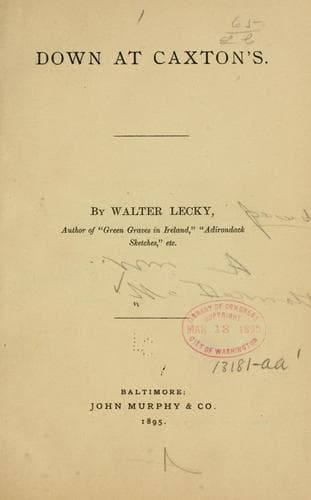
American literature -- 19th century -- History and criticism; American literature -- Catholic authors -- History and criticism
As it is, your books are snuffed
out by the immense amount of trash handled by the ordinary Catholic
bookseller, and you help this by writing deep-dyed hypocrisy of the
trash-makers. Azarias mildly expresses my idea in one of his posthumous
papers: “Catholic reviewers must plead guilty to the impeachment of
having been in the past too laudatory of inferior work.” The stories
of that sterling man, Malcolm Johnston, called Dukesborough Tales, I
once gave to a wretched family. On visiting them a week after, what
delight it was to hear the health-giving laughter they had found in
them. To another family I gave Billy Downs. Asking how they liked them,
I was told that they were as “fine as silk.” A youth of fourteen, his
face decidedly humorous, volunteered the criticism that “Billy had
no grit.” During the illness of four or five patients of mine I read
the assembled family “Chumming With a Savage,” “Joe of Lahaina.” When
I came to the final sentence in Joe, where Charlie Stoddard leaves
him “sitting and singing in the mouth of his grave—clothed all in
death,” two of the youngsters burst into tears, while the father much
agitated, said, “Doctor, I don’t see how he had the heart to leave
him.” They were so much attached to the book that, although it had
been my choice old chum in many a land, I gave it to them. Lately I
gave “Life Around Us,” a collection of stories by Maurice F. Egan.
It was a great success. Egan has the true touch for the masses when
he wishes. Another little story much prized was Nugent Robinson’s
“Better Than Gold.” To these might be added in cheap form those of
Marian Brunowe, May Crowley, Helen Sweeney, a promising young writer,
and Lelia Bugg. How to reach the poor with these books presents few
obstacles. Cardinal Vaughan has solved the difficulty in England.
Attach to every parish church in city and country a library of well
selected interesting Catholic books. Let their circulation be free of
charge. The great majority of Catholic poor attend some of the Sunday
Masses. If the library is open, they will gladly take a book home. The
reading of this book will instil a taste. They will tell their friends
of it. It will be the subject of many a chat. If it is cheap, not a
few of the neighbors will wish to purchase it. Their criticism, always
racy and generally correct, will, as Birrell has pointed out in one
of his essays, be its sure pass to success. After a year’s friendly
intercourse the library will become a necessity, and they will gladly
pay a fee for their week’s delight. The author that has won their
hearts will be on their lips, his new books, on account of old ties,
will be eagerly purchased and loudly proclaimed.
Public-domain text, read in full here on John Shaqi.
Reviews
Reviews
No reviews yet
Be the first to share your thoughts on this work.
Elsewhere in the archive
Join the Discussion
Join the discussion
Sign in to leave a comment or review.
Sign InorCreate an account