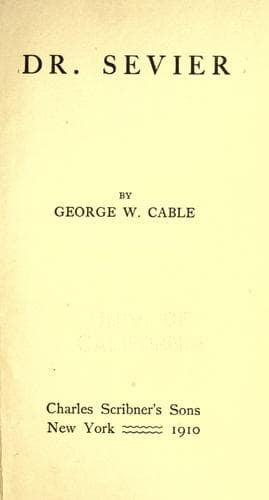
New Orleans (La.) -- Social life and customs -- 19th century -- Fiction; Physicians -- Fiction
Dr. Sevier stamped his wet feet on the pavement of the hospital porch.
It was afternoon of the day following that of the rain. The water still
covering the streets about the hospital had not prevented his carriage
from splashing through it on his double daily round. A narrow and
unsteady plank spanned the immersed sidewalk. Three times, going and
coming, he had crossed it safely, and this fourth time he had made half
the distance well enough; but, hearing distant cheers and laughter, he
looked up street; when--splatter!--and the cheers were redoubled.
"Pretty thing to laugh at!" he muttered. Two or three bystanders,
leaning on their umbrellas in the lodge at the gate and in the porch,
where he stood stamping, turned their backs and smoothed their mouths.
"Hah!" said the tall Doctor, stamping harder. Stamp!--stamp! He shook
his leg.--"Bah!" He stamped the other long, slender, wet foot and looked
down at it, turning one side and then the other.--"F-fah!"--The first
one again.--"Pshaw!"--The other.--Stamp!--stamp!--"_Right_--_into_
it!--up to my _ankles!_" He looked around with a slight scowl at one
man, who seemed taken with a sudden softening of the spine and knees,
and who turned his back quickly and fell against another, who, also with
his back turned, was leaning tremulously against a pillar.
But the object of mirth did not tarry. He went as he was to Mary's room,
and found her much better--as, indeed, he had done at every visit. He
sat by her bed and listened to her story.
"Why, Doctor, you see, we did nicely for a while. John went on getting
the same kind of work, and pleasing everybody, of course, and all he
lacked was finding something permanent. Still, we passed through one
month after another, and we really began to think the sun was coming
out, so to speak."
"Well, I thought so, too," put in the Doctor. "I thought if it didn't
you'd let me know."
"Why, no, Doctor, we couldn't do that; you couldn't be taking care of
well people."
"Well," said the Doctor, dropping that point, "I suppose as the busy
season began to wane that mode of livelihood, of course, disappeared."
"Yes,"--a little one-sided smile,--"and so did our money. And then, of
course,"--she slightly lifted and waved her hand.
"You had to live," said Dr. Sevier, sincerely.
She smiled again, with abstracted eyes. "We thought we'd like to," she
said. "I didn't mind the loss of the things so much,--except the little
table we ate from. You remember that little round table, don't you?"
The visitor had not the heart to say no. He nodded.
"When that went there was but one thing left that could go."
"Not your bed?"
"The bedstead; yes."
"You didn't sell your bed, Mrs. Richling?"
The tears gushed from her eyes. She made a sign of assent.
"But then," she resumed, "we made an excellent arrangement with a good
woman who had just lost her husband, and wanted to live cheaply, too."
"What amuses you, madam?"
Public-domain text, read in full here on John Shaqi.
Reviews
Reviews
No reviews yet
Be the first to share your thoughts on this work.
Join the Discussion
Join the discussion
Sign in to leave a comment or review.
Sign InorCreate an account