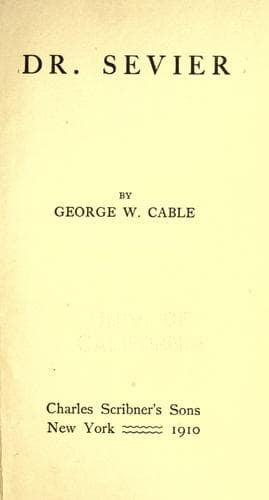
New Orleans (La.) -- Social life and customs -- 19th century -- Fiction; Physicians -- Fiction
He turned without any distinct motive and, retracing his steps to the
corner, passed up across Poydras street. A little way above it he paused
to look at some machinery in motion. He liked machinery,--for itself
rather than for its results. He would have gone in and examined the
workings of this apparatus had it not been for the sign above his head,
"No Admittance." Those words always seemed painted for him. A slight
modification in Richling's character might have made him an inventor.
Some other faint difference, and he might have been a writer, a
historian, an essayist, or even--there is no telling--a well-fed poet.
With the question of food, raiment, and shelter permanently settled,
he might have become one of those resplendent flash lights that at
intervals dart their beams across the dark waters of the world's
ignorance, hardly from new continents, but from the observatory, the
study, the laboratory. But he was none of these. There had been a crime
committed somewhere in his bringing up, and as a result he stood in the
thick of life's battle, weaponless. He gazed upon machinery with
childlike wonder; but when he looked around and saw on every hand
men,--good fellows who ate in their shirt-sleeves at restaurants, told
broad jokes, spread their mouths and smote their sides when they
laughed, and whose best wit was to bombard one another with bread-crusts
and hide behind the sugar-bowl; men whom he could have taught in every
kind of knowledge that they were capable of grasping, except the
knowledge of how to get money,--when he saw these men, as it seemed to
him, grow rich daily by simply flipping beans into each other's faces,
or slapping each other on the back, the wonder of machinery was
eclipsed. Do as they did? He? He could no more reach a conviction as to
what the price of corn would be to-morrow than he could remember what
the price of sugar was yesterday.
He called himself an accountant, gulping down his secret pride with an
amiable glow that commanded, instantly, an amused esteem. And, to judge
by his evident familiarity with Tonti's beautiful scheme of mercantile
records, he certainly--those guessed whose books he had extricated
from confusion--had handled money and money values in days before his
unexplained coming to New Orleans. Yet a close observer would have
noticed that he grasped these tasks only as problems, treated them in
their mathematical and enigmatical aspect, and solved them without any
appreciation of their concrete values. When they were done he felt less
personal interest in them than in the architectural beauty of the
store-front, whose window-shutters he had never helped to close without
a little heart-leap of pleasure.
But, standing thus, and looking in at the machinery, a man touched him
on the shoulder.
Public-domain text, read in full here on John Shaqi.
Reviews
Reviews
No reviews yet
Be the first to share your thoughts on this work.
Elsewhere in the archive
Join the Discussion
Join the discussion
Sign in to leave a comment or review.
Sign InorCreate an account