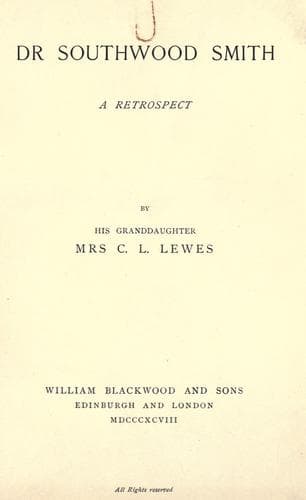
Dr. Southwood Smith: A RetrospectLewes, Gertrude Hill
History
Dr. Southwood Smith: A Retrospect
Lewes, Gertrude Hill
Physicians -- Great Britain -- Biography; Smith, Southwood, 1788-1861
Two years later he was able to carry out his cherished hope of returning
to Italy, and we went to Florence, where his daughter Emily had been
living for some years. She welcomed us to the rooms she had secured in
an old palace beyond the Arno--to the artistic Italian surroundings of
which she had added something of the atmosphere of an English home.
His delight in the art and nature of Florence and its environs was
intense, and the beauty of land and sky seems to make a fitting setting
for the end of such a life as his.
He stood on the old jeweller's bridge, one autumn evening late in
November, and watched the sun go down behind the western hill of the
rushing Arno; and the sunset of his own life came soon after. Perhaps he
had lingered too long gazing at this beautiful scene; for a chill,
producing rapid bronchitis, took him from us on the 10th December 1861.
Towards the end, when he knew he was passing away, after other gentle
loving words, almost his last were--with a sweet triumphant smile--"Draw
up the blind and let me see the stars; for I still love the beauty."
* * * * *
[Illustration: Porta Pinti.]
At the cemetery at Porta Pinti are some sombre gates with, over them,
the words "Ils se reposent de leurs travaux, et leurs oeuvres les
suivent." Those black gates opened one sunny December morning and showed
a sloping avenue of marble tombs, tangles of pink and of white China
roses in full flower falling over them, and at the end a tall white
cross shining in the sunlight against the blue Italian sky,--fit type of
the black gates of death, which had rolled back to let him pass into the
Eternal Light beyond.
There we left him in completest trust, our "Knight Errant," after his
life's warfare.
* * * * *
For there is a poem by Adelaide Procter (on whom written I know not)
which seems to give, with the full force of poetical presentation, the
spirit of the Life I have tried to depict. It even seems to follow the
very order of the periods of that life--_our_ hero following the course
of _hers_; and thus fulfilling Mrs Browning's words when she says--
"Ingemisco, ingemisco!
Is ever a lament begun
By any mourner under sun
Which, ere it endeth, suits but one?"
In my extract-book the following lines have lain away for the nearly
forty years which have passed since he went from us, and they still
remain, to me, the best expression of what he was. I find, in pencil,
against the verses the place or date which they symbolise.
If those who have read these pages see their aptness, they will learn
from them, more than from any words of mine, what measure of man he was.
A KNIGHT ERRANT.
"Though he lived and died amongst us,
Yet his name may be enrolled
With the knights whose deeds of daring
Ancient chronicles have told.
Public-domain text, read in full here on John Shaqi.
Reviews
Reviews
No reviews yet
Be the first to share your thoughts on this work.
Elsewhere in the archive
Join the Discussion
Join the discussion
Sign in to leave a comment or review.
Sign InorCreate an account