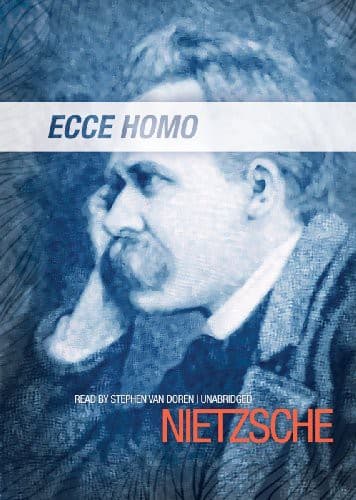
Ecce Homo: Complete Works, Volume SeventeenNietzsche, Friedrich Wilhelm
PhilosophyPhilosophy
Ecce Homo: Complete Works, Volume Seventeen
Nietzsche, Friedrich Wilhelm
Nietzsche, Friedrich Wilhelm, 1844-1900; Philosophers -- Germany -- Biography
My work for the years that followed was prescribed as distinctly
as possible. Now that the yea-saying part of my life-task was
accomplished, there came the turn of the negative portion, both in
word and deed: the transvaluation of all values that had existed
hitherto, the great war,--the conjuring-up of the day when the fatal
outcome of the struggle would be decided. Meanwhile, I had slowly to
look about me for my peers, for those who, _out of strength,_ would
proffer me a helping hand in my work of destruction. From that time
onward, all my writings are so much bait: maybe I understand as much
about fishing as most people? If nothing was _caught,_ it was not I who
was at fault _There were no fish to come and bite._
2
In all its essential points, this book (1886) is a criticism of
_modernity,_ embracing the modern sciences, arts, even politics,
together with certain indications as to a type which would be the
reverse of modern man, or as little like him as possible, a noble
and yea-saying type. In this last respect the book is a _school
for gentlemen_--the term _gentleman_ being understood here in a
much more spiritual and radical sense than it has implied hitherto.
All those things of which the age is proud,--as, for instance,
far-famed "objectivity," "sympathy with all that suffers," "the
historical sense," with its subjection to foreign tastes, with its
lying-in-the-dust before _petits faits,_ and the rage for science,--are
shown to be the contradiction of the type recommended, and are
regarded as almost ill-bred. If you remember that this book follows
upon _Zarathustra,_ you may possibly guess to what system of diet it
owes its life. The eye which, owing to tremendous constraint, has
become accustomed to see at a great distance,--_Zarathustra_ is even
more far-sighted than the Tsar,--is here forced to focus sharply that
which is close at hand, the present time, the things that lie about
him. In all the aphorisms and more particularly in the form of this
book, the reader will find the same _voluntary_ turning away from those
instincts which made a _Zarathustra_ a possible feat. Refinement in
form, in aspiration, and in the art of keeping silent, are its more or
less obvious qualities; psychology is handled with deliberate hardness
and cruelty,--the whole book does not contain one single good-natured
word.... All this sort of thing refreshes a man. Who can guess the kind
of recreation that is necessary after such an expenditure of goodness
as is to be found in _Zarathustra_? From a theological standpoint--now
pay ye heed; for it is but on rare occasions that I speak as a
theologian--it was God Himself who, at the end of His great work,
coiled Himself up in the form of a serpent at the foot of the tree of
knowledge. It was thus that He recovered from being a God.... He had
made everything too beautiful.... The devil is simply God's moment of
idleness, on that seventh day.
"THE GENEALOGY OF MORALS: A POLEMIC"
Public-domain text, read in full here on John Shaqi.
Reviews
Reviews
No reviews yet
Be the first to share your thoughts on this work.
Elsewhere in the archive
Join the Discussion
Join the discussion
Sign in to leave a comment or review.
Sign InorCreate an account