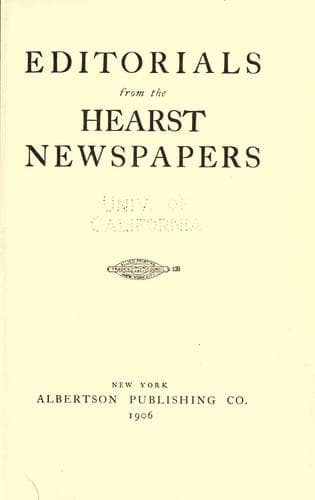
Editorials from the Hearst NewspapersBrisbane, Arthur
Philosophy
Editorials from the Hearst Newspapers
Brisbane, Arthur
Editorials; Essays
Last of all (and we apologize for this unforgivably long
editorial), let us discuss the question of foreign labor. The
capitalist complains that the Hungarian, "the brutal, ignorant
foreigner," makes much of the trouble, and "wants as much as an
American."
Loud is this cry against the foreign laborer. And the ignorant,
know-nothing American workman joins in the cry only too
willingly.
Who brings in those foreign laborers by the shipload, Mr.
Mineowner?
Who rounds up cargoes of Slavs on the other side and brings them
here to cut the wages and the living of the native-born?
Who shrieks dolefully, Mr. Miner, when the Slav shows that he is
a MAN brave and willing to prove worthy of freedom by joining
the army of union labor?
The Slav and the Hungarian ARE HERE, and their children will
be here when we are dead.
Which is better, to underpay them, treat them like cattle, fill
them with just hatred of unjust discrimination, or give them a
chance to be men?
Shall their children grow up ignorant mine slaves? Or shall they
go to that factory of honest citizenship--the public school--to
be improved as we have all been improved, whether we came
originally from Hungary, Ireland, England, France, Russia, or
elsewhere?
The struggle of the strikers, like all great struggles, is
sometimes unjust. It has not always the wisest or the most
unselfish leaders.
But it is an effort to improve the AVERAGE CONDITION OF
HUMANITY. Help that effort.
"LIMITING THE AMOUNT OF A DAY'S WORK"
THERE'S A GOOD DEAL OF NONSENSE TALKED ON THIS SUBJECT
An honest, well-meaning clergyman talked the other day on labor
unions, and wandered out of his depth. As a rule, clergymen,
having studied the teachings of Christ, are aware that they ought
to be on the side of the workingman. Hence the strongest
supporters of the union are found among the clergy.
The mistake of the clergyman whom we mention is discussed here,
because it is often made by well-meaning, but narrow-minded,
citizens.
He spoke of "the custom union labor has of limiting a day's work
AND OTHER DISHONEST PRACTICES."
By limiting a day's work, the reverend gentleman referred to the
rule existing in certain unions regulating the maximum day's
labor.
That rule does exist, and sometimes undoubtedly--labor union men
not being angels or cherubim--the rule may be pushed to extremes.
But on the whole the rule is necessary, and it works for good.
We shall tell this clergyman and other citizens one special
reason for limiting the day's work.
Public-domain text, read in full here on John Shaqi.
Reviews
Reviews
No reviews yet
Be the first to share your thoughts on this work.
Join the Discussion
Join the discussion
Sign in to leave a comment or review.
Sign InorCreate an account