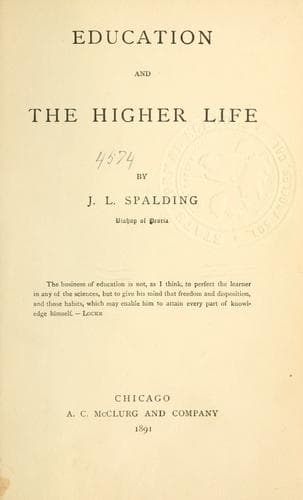
Education and the Higher LifeSpalding, John Lancaster
Religion
Education and the Higher Life
Spalding, John Lancaster
Education
Now, if all that may be known and desired is reduced to this material
expression, how dull and beggarly does not life become,--mere atomic
integration and disintegration, the poor human pneumatic-machine purring
along the dusty road of matter, bound and helpless and soulless as a
clanking engine! No high life, in individuals or nations, is to be hoped
for, unless it is enrooted in the infinite spiritual reality,--in God.
It is forever indubitable that the highest is not material, and no
argument is therefore needed to show that when spiritual ideals lose
their power of attraction, life sinks to lower beds.
Sight is the noblest sense, and the starlit sky is the most sublime
object we can behold. But what do we in reality see there? Only a kind
of large tent, dimly lighted with gas jets. This is the noblest thing
the noblest sense reveals. But let the soul appear, and the tent flies
into invisible shreds; the heavens break open from abyss to abyss, still
widening into limitless expanse, until imagination reels. The gas jets
grow into suns, blazing since innumerable ages with unendurable light,
and binding whole planetary systems into harmony and life. So infinitely
does the soul transcend the senses! The world it lives in is boundless,
eternal, sublime. This is its home; this the sphere in which it grows,
and awakens to consciousness of kinship with God. This is the
fathomless, shoreless abyss of being wherein it is plunged, from which
it draws its life, its yearning for the absolute, its undying hope, its
love of the best, its craving for immortality, its instinct for eternal
things. To condemn it to work merely for money, for position, for
applause, for pleasure, is to degrade it to the condition of a slave. It
is as though we should take some supreme poet or hero and bid him break
stones or grind corn,--he who has the faculty to give to truth its
divinest form, and to lift the hearts of nations to the love of heavenly
things.
Whatever our lot on earth may be--whether we toil with the hand, with
the brain, or with the heart--we may not bind the soul to any slavish
service. Let us do our work like men,--till the soil, build homes,
refine brute matter, be learned in law, in medicine, in theology; but
let us never chain our souls to what they work in. No earthly work can
lay claim to the whole life of man; for every man is born for God, for
the Universe, and may not narrow his mind. We must have some practical
thing to do in the world,--some way of living which will place us in
harmony with the requirements and needs of earthly life; and what this
daily business of ours shall be, each one, in view of his endowments and
surroundings, must decide for himself.
Public-domain text, read in full here on John Shaqi.
Reviews
Reviews
No reviews yet
Be the first to share your thoughts on this work.
Join the Discussion
Join the discussion
Sign in to leave a comment or review.
Sign InorCreate an account