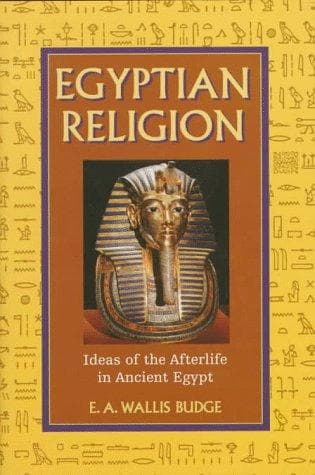
Egyptian Ideas of the Future LifeBudge, E. A. Wallis (Ernest Alfred Wallis), Sir
ReligionComparative
Egyptian Ideas of the Future Life
Budge, E. A. Wallis (Ernest Alfred Wallis), Sir
Egypt -- Religion; Eschatology, Egyptian; Future life
scorching power of the sun, and of the gentle heat thereof,
respectively. (8) SERQ, who was a form of Isis. (9) TA-URT (Thoueris),
who was the genetrix of the gods. (10) UATCHET, who was a form of
Hather, and who had dominion over the northern sky, just as NEKHEBET was
mistress of the southern sky. (11) NEHEB-KA, who was a goddess who
possessed magical powers, and in some respects resembled Isis in her
attributes. (12) SEBAK, who was a form of the Sun-god, and was in later
times confounded with Sebak, or Sebek, the friend of Set. (13) AMSU (or
MIN or KUEM), who was the personification of the generative and
reproductive powers of nature. (14) BEB or BABA, who was the "firstborn
son of Osiris." (15) H[=a]pi, who was the god of the Nile, and with whom
most of the great gods were identified.
The names of the beings who at one time or another were called "gods" in
Egypt are so numerous that a mere list of them would fill scores of
pages, and in a work of this kind would be out of place. The reader is,
therefore, referred to Lanzone's _Mitologia Egizia_, where a
considerable number are enumerated and described.
CHAPTER IV.
THE JUDGMENT OF THE DEAD.
The belief that the deeds done in the body would be subjected to an
analysis and scrutiny by the divine powers after the death of a man
belongs to the earliest period of Egyptian civilization, and this belief
remained substantially the same in all generations. Though we have no
information as to the locality where the Last Judgment took place, or
whether the Egyptian soul passed into the judgment-hall immediately
after the death of the body, or after the mummification was ended and
the body was deposited in the tomb, it is quite certain that the belief
in the judgment was as deeply rooted in the Egyptians as the belief in
immortality. There seems to have been no idea of a general judgment when
all those who had lived in the world should receive their reward for the
deeds done in the body; on the contrary, all the evidence available goes
to show that each soul was dealt with individually, and was either
permitted to pass into the kingdom of Osiris and of the blessed, or was
destroyed straightway. Certain passages in the texts seem to suggest the
idea of the existence of a place for departed spirits wherein the souls
condemned in the judgment might dwell, but it must be remembered that it
was the enemies of R[=a], the Sun-god, that inhabited this region; and
it is impossible to imagine that the divine powers who presided over the
judgment would permit the souls of the wicked to live after they had
been condemned and to become enemies of those who were pure and blessed.
On the other hand, if we attach any importance to the ideas of the Copts
upon this subject, and consider that they represent ancient beliefs
which they derived from the Egyptians traditionally, it must be admitted
that the Egyptian underworld contained some region wherein the souls of
the wicked were punished for an indefinite period.
Public-domain text, read in full here on John Shaqi.
Reviews
Reviews
No reviews yet
Be the first to share your thoughts on this work.
Elsewhere in the archive
Join the Discussion
Join the discussion
Sign in to leave a comment or review.
Sign InorCreate an account