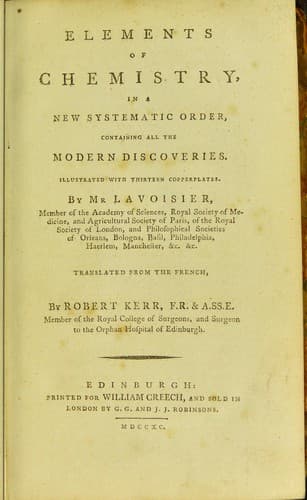
Elements of Chemistry,: In a New Systematic Order, Containing all the Modern Discoveries — John Shaqi
Elements of Chemistry,: In a New Systematic Order, Containing all the Modern DiscoveriesLavoisier, Antoine Laurent
Science
Elements of Chemistry,: In a New Systematic Order, Containing all the Modern Discoveries
Lavoisier, Antoine Laurent
Chemistry -- Early works to 1800
very last portion of air which remains spreads itself uniformly through
the whole capacity of the vessel, however large, fills it completely
throughout, and presses every where against its sides: We cannot,
however, explain this effect, without supposing that the particles make
an effort to separate themselves on every side, and we are quite
ignorant at what distance, or what degree of rarefaction, this effort
ceases to act.
Here, therefore, exists a true repulsion between the particles of
elastic fluids; at least, circumstances take place exactly as if such a
repulsion actually existed; and we have very good right to conclude,
that the particles of caloric mutually repel each other. When we are
once permitted to suppose this repelling force, the _rationale_ of the
formation of gasses, or aeriform fluids, becomes perfectly simple; tho'
we must, at the same time, allow, that it is extremely difficult to form
an accurate conception of this repulsive force acting upon very minute
particles placed at great distances from each other.
It is, perhaps, more natural to suppose, that the particles of caloric
have a stronger mutual attraction than those of any other substance, and
that these latter particles are forced asunder in consequence of this
superior attraction between the particles of the caloric, which forces
them between the particles of other bodies, that they may be able to
reunite with each other. We have somewhat analogous to this idea in the
phenomena which occur when a dry sponge is dipt into water: The sponge
swells; its particles separate from each other; and all its intervals
are filled up by the water. It is evident, that the sponge, in the act
of swelling, has acquired a greater capacity for containing water than
it had when dry. But we cannot certainly maintain, that the introduction
of water between the particles of the sponge has endowed them with a
repulsive power, which tends to separate them from each other; on the
contrary, the whole phenomena are produced by means of attractive
powers; and these are, _first_, The gravity of the water, and the power
which it exerts on every side, in common with all other fluids; _2dly_,
The force of attraction which takes place between the particles of the
water, causing them to unite together; _3dly_, The mutual attraction of
the particles of the sponge with each other; and, _lastly_, The
reciprocal attraction which exists between the particles of the sponge
and those of the water. It is easy to understand, that the explanation
of this fact depends upon properly appreciating the intensity of, and
connection between, these several powers. It is probable, that the
separation of the particles of bodies, occasioned by caloric, depends in
a similar manner upon a certain combination of different attractive
powers, which, in conformity with the imperfection of our knowledge, we
endeavour to express by saying, that caloric communicates a power of
repulsion to the particles of bodies.
FOOTNOTES:
Public-domain text, read in full here on John Shaqi.
Reviews
Reviews
No reviews yet
Be the first to share your thoughts on this work.
Join the Discussion
Join the discussion
Sign in to leave a comment or review.
Sign InorCreate an account