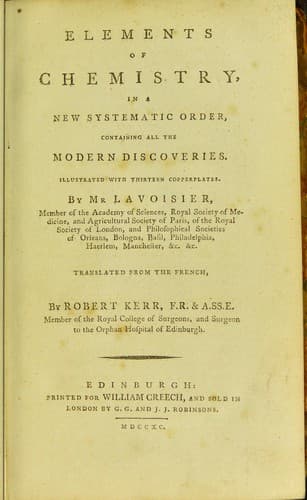
Elements of Chemistry,: In a New Systematic Order, Containing all the Modern DiscoveriesLavoisier, Antoine Laurent
Science
Elements of Chemistry,: In a New Systematic Order, Containing all the Modern Discoveries
Lavoisier, Antoine Laurent
Chemistry -- Early works to 1800
The most simple and most exact method for determining this latter point,
is that described by Mr de la Place, in the Memoirs of the Academy, No.
1780, p. 364; a summary explanation of which will be found towards the
conclusion of this work. This method consists in placing a body, or a
combination of bodies, from which caloric is disengaging, in the midst
of a hollow sphere of ice; and the quantity of ice melted becomes an
exact measure of the quantity of caloric disengaged. It is possible, by
means of the apparatus which we have caused to be constructed upon this
plan, to determine, not as has been pretended, the capacity of bodies
for containing heat, but the ratio of the increase or diminution of
capacity produced by determinate degrees of temperature. It is easy with
the same apparatus, by means of divers combinations of experiments, to
determine the quantity of caloric requisite for converting solid
substances into liquids, and liquids into elastic aeriform fluids; and,
_vice versa_, what quantity of caloric escapes from elastic vapours in
changing to liquids, and what quantity escapes from liquids during their
conversion into solids. Perhaps, when experiments have been made with
sufficient accuracy, we may one day be able to determine the
proportional quantity of caloric, necessary for producing the several
species of gasses. I shall hereafter, in a separate chapter, give an
account of the principal results of such experiments as have been made
upon this head.
It remains, before finishing this article, to say a few words relative
to the cause of the elasticity of gasses, and of fluids in the state of
vapour. It is by no means difficult to perceive that this elasticity
depends upon that of caloric, which seems to be the most eminently
elastic body in nature. Nothing is more readily conceived, than that one
body should become elastic by entering into combination with another
body possessed of that quality. We must allow that this is only an
explanation of elasticity, by an assumption of elasticity, and that we
thus only remove the difficulty one step farther, and that the nature of
elasticity, and the reason for caloric being elastic, remains still
unexplained. Elasticity in the abstract is nothing more than that
quality of the particles of bodies by which they recede from each other
when forced together. This tendency in the particles of caloric to
separate, takes place even at considerable distances. We shall be
satisfied of this, when we consider that air is susceptible of
undergoing great compression, which supposes that its particles were
previously very distant from each other; for the power of approaching
together certainly supposes a previous distance, at least equal to the
degree of approach. Consequently, those particles of the air, which are
already considerably distant from each other, tend to separate still
farther. In fact, if we produce Boyle's vacuum in a large receiver, the
Public-domain text, read in full here on John Shaqi.
Reviews
Reviews
No reviews yet
Be the first to share your thoughts on this work.
Join the Discussion
Join the discussion
Sign in to leave a comment or review.
Sign InorCreate an account