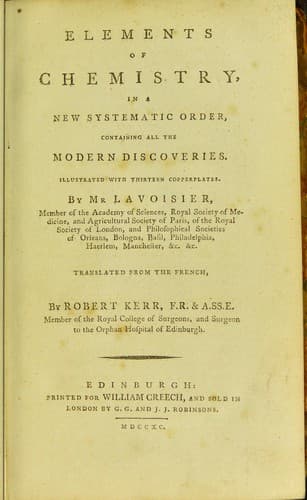
Elements of Chemistry,: In a New Systematic Order, Containing all the Modern DiscoveriesLavoisier, Antoine Laurent
Science
Elements of Chemistry,: In a New Systematic Order, Containing all the Modern Discoveries
Lavoisier, Antoine Laurent
Chemistry -- Early works to 1800
The better to determine our ideas relating to this subject, which has
not hitherto been sufficiently considered, let us, for a moment,
conceive what change would take place in the various substances which
compose our earth, if its temperature were suddenly altered. If, for
instance, we were suddenly transported into the region of the planet
Mercury, where probably the common temperature is much superior to that
of boiling water, the water of the earth, and all the other fluids which
are susceptible of the gasseous state, at a temperature near to that of
boiling water, even quicksilver itself, would become rarified; and all
these substances would be changed into permanent aeriform fluids or
gasses, which would become part of the new atmosphere. These new species
of airs or gasses would mix with those already existing, and certain
reciprocal decompositions and new combinations would take place, until
such time as all the elective attractions or affinities subsisting
amongst all these new and old gasseous substances had operated fully;
after which, the elementary principles composing these gasses, being
saturated, would remain at rest. We must attend to this, however, that,
even in the above hypothetical situation, certain bounds would occur to
the evaporation of these substances, produced by that very evaporation
itself; for as, in proportion to the increase of elastic fluids, the
pressure of the atmosphere would be augmented, as every degree of
pressure tends, in some measure, to prevent evaporation, and as even the
most evaporable fluids can resist the operation of a very high
temperature without evaporating, if prevented by a proportionally
stronger compression, water and all other liquids being able to sustain
a red heat in Papin's digester; we must admit, that the new atmosphere
would at last arrive at such a degree of weight, that the water which
had not hitherto evaporated would cease to boil, and, of consequence,
would remain liquid; so that, even upon this supposition, as in all
others of the same nature, the increasing gravity of the atmosphere
would find certain limits which it could not exceed. We might even
extend these reflections greatly farther, and examine what change might
be produced in such situations upon stones, salts, and the greater part
of the fusible substances which compose the mass of our earth. These
would be softened, fused, and changed into fluids, &c.: But these
speculations carry me from my object, to which I hasten to return.
Public-domain text, read in full here on John Shaqi.
Reviews
Reviews
No reviews yet
Be the first to share your thoughts on this work.
Join the Discussion
Join the discussion
Sign in to leave a comment or review.
Sign InorCreate an account