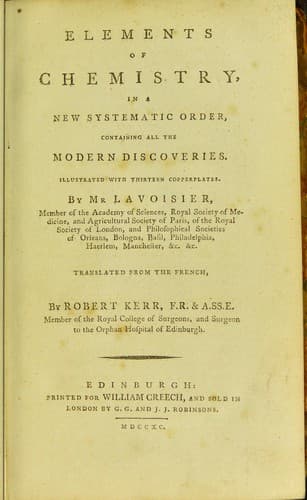
Elements of Chemistry,: In a New Systematic Order, Containing all the Modern DiscoveriesLavoisier, Antoine Laurent
Science
Elements of Chemistry,: In a New Systematic Order, Containing all the Modern Discoveries
Lavoisier, Antoine Laurent
Chemistry -- Early works to 1800
By a contrary supposition to the one we have been forming, if the earth
were suddenly transported into a very cold region, the water which at
present composes our seas, rivers, and springs, and probably the greater
number of the fluids we are acquainted with, would be converted into
solid mountains and hard rocks, at first diaphanous and homogeneous,
like rock crystal, but which, in time, becoming mixed with foreign and
heterogeneous substances, would become opake stones of various colours.
In this case, the air, or at least some part of the aeriform fluids
which now compose the mass of our atmosphere, would doubtless lose its
elasticity for want of a sufficient temperature to retain them in that
state: They would return to the liquid state of existence, and new
liquids would be formed, of whose properties we cannot, at present, form
the most distant idea.
These two opposite suppositions give a distinct proof of the following
corollaries: _First_, That _solidity_, _liquidity_, and _aeriform
elasticity_, are only three different states of existence of the same
matter, or three particular modifications which almost all substances
are susceptible of assuming successively, and which solely depend upon
the degree of temperature to which they are exposed; or, in other words,
upon the quantity of caloric with which they are penetrated[8]. _2dly_,
That it is extremely probable that air is a fluid naturally existing in
a state of vapour; or, as we may better express it, that our atmosphere
is a compound of all the fluids which are susceptible of the vaporous
or permanently elastic state, in the usual temperature, and under the
common pressure. _3dly_, That it is not impossible we may discover, in
our atmosphere, certain substances naturally very compact, even metals
themselves; as a metallic substance, for instance, only a little more
volatile than mercury, might exist in that situation.
Public-domain text, read in full here on John Shaqi.
Reviews
Reviews
No reviews yet
Be the first to share your thoughts on this work.
Join the Discussion
Join the discussion
Sign in to leave a comment or review.
Sign InorCreate an account