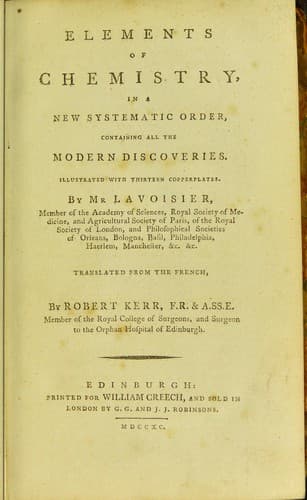
Elements of Chemistry,: In a New Systematic Order, Containing all the Modern DiscoveriesLavoisier, Antoine Laurent
Science
Elements of Chemistry,: In a New Systematic Order, Containing all the Modern Discoveries
Lavoisier, Antoine Laurent
Chemistry -- Early works to 1800
We have already seen, that the atmospheric air is composed of two
gasses, or aeriform fluids, one of which is capable, by respiration, of
contributing to animal life, and in which metals are calcinable, and
combustible bodies may burn; the other, on the contrary, is endowed with
directly opposite qualities; it cannot be breathed by animals, neither
will it admit of the combustion of inflammable bodies, nor of the
calcination of metals. We have given to the base of the former, or
respirable portion of the air, the name of _oxygen_, from [Greek: oxys]
_acidum_, and [Greek: geinomas], _gignor_; because, in reality, one of
the most general properties of this base is to form acids, by combining
with many different substances. The union of this base with caloric we
term _oxygen gas_, which is the same with what was formerly called
_pure_, or _vital air_. The weight of this gas, at the temperature of
10 deg. (54.50), and under a pressure equal to 28 inches of the barometer,
is half a grain for each cubical inch, or one ounce and a half to each
cubical foot.
The chemical properties of the noxious portion of atmospheric air being
hitherto but little known, we have been satisfied to derive the name of
its base from its known quality of killing such animals as are forced to
breathe it, giving it the name of _azote_, from the Greek privitive
particle [Greek: a] and [Greek: xae], vita; hence the name of the
noxious part of atmospheric air is _azotic gas_; the weight of which, in
the same temperature, and under the same pressure, is 1 oz. 2 gros
and 48 grs. to the cubical foot, or 0.4444 of a grain to the cubical
inch. We cannot deny that this name appears somewhat extraordinary; but
this must be the case with all new terms, which cannot be expected to
become familiar until they have been some time in use. We long
endeavoured to find a more proper designation without success; it was at
first proposed to call it _alkaligen gas_, as, from the experiments of
Mr Berthollet, it appears to enter into the composition of ammoniac, or
volatile alkali; but then, we have as yet no proof of its making one of
the constituent elements of the other alkalies; beside, it is proved to
compose a part of the nitric acid, which gives as good reason to have
called it _nitrigen_. For these reasons, finding it necessary to reject
any name upon systematic principles, we have considered that we run no
risk of mistake in adopting the terms of _azote_, and _azotic gas_,
which only express a matter of fact, or that property which it
possesses, of depriving such animals as breathe it of their lives.
Public-domain text, read in full here on John Shaqi.
Reviews
Reviews
No reviews yet
Be the first to share your thoughts on this work.
Elsewhere in the archive
Join the Discussion
Join the discussion
Sign in to leave a comment or review.
Sign InorCreate an account