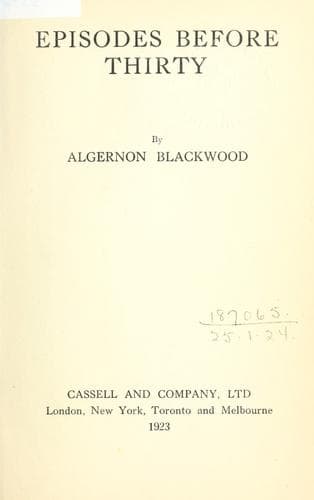
Authors, English -- 20th century -- Biography; Blackwood, Algernon, 1869-1951
With bigger experience may come, in time, a better view; equally, it
may never come. Proportion is not so easily recovered, for the mind,
at an impressionable age, has been deeply marked. The good, the
beautiful, the lovely, in a New York paper, is very rarely “news”; it
is considered as fake, bunkum, humbug, a pose; it is looked at askance,
regarded with suspicion, as assumed by someone for the purpose of a
“deal”; it is rarely worth its space, at any rate. A reporter finds
himself in a cynical school; he is lucky if he escape in the end with a
single rag of illusion to his back. If he has believed, up to the age
of twenty-one, as I did, that the large majority of people are decent,
kindly, honest folk, he will probably lose even that last single rag.
On the _Evening Sun_, certainly, it was not the good, the beautiful,
the clean, that constituted the most interesting news and got scare
headlines and extra editions. I give, of course, merely the impression
made upon my own mind and type, coloured as these were, some thirty
years ago, by a characteristically ignorant and innocent upbringing....
The important newspapers, in those days, were all “down town,” grouped
about Park Row, and the shabby, tumble-down building of the _Sun_
was not imposing. The World and Times towered above it; the _Morning
Advertiser_, the _Evening Telegram_, even the _Recorder_ were better
housed; the _Journal_ had not yet brought W. R. Hearst’s methods from
San Francisco. For all its humble offices, the _Sun_ was, perhaps, the
greatest power in the city. It was openly Tammany; it had a grand,
courageous editor, Charles A. Dana. “Charles A.” was an imposing
figure, a man of immense ability, a “crank” perhaps in certain ways,
but a respected chief of outstanding character and fearless policy....
My own chief, however, was W. C. McCloy, and the offices where he
reigned as managing editor were housed on the top floor of the rickety
building, with the machinery making such a din and roar and clatter
that we had to shout to make ourselves heard at all. Metal sheets
that clanged and pinged as we walked on them covered the floors. It
was amid this pandemonium I had my first interview with him. An iron
spiral staircase led from the quiet workrooms of the _Morning Sun_, on
the first floor, to the dark, low-ceilinged space, where the whirring
printing presses were not even partitioned off from the tables of
editorial departments or reporters. It was like a factory going at full
speed. Hours were 8.30 A.M. to 6.30 P.M., or later if an extra--a 6th
or 7th--edition was called for. I arrived at 8.15.
Public-domain text, read in full here on John Shaqi.
Reviews
Reviews
No reviews yet
Be the first to share your thoughts on this work.
Elsewhere in the archive
Join the Discussion
Join the discussion
Sign in to leave a comment or review.
Sign InorCreate an account