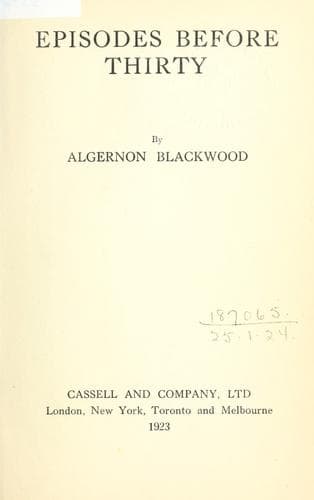
Authors, English -- 20th century -- Biography; Blackwood, Algernon, 1869-1951
My first week’s reporting passed in a whirl of feverish excitement.
Assignments of every possible kind were hurled at me. I raced and
flew about. The “Britisher,” the “English accent,” were a source of
amusement to the staff, but there was no ill-nature. Cooper seemed to
like me; he chuckled; he even gave me hints. “Well, Mr. Britisher, did
you get it this time?” Few of my first efforts were used, the flimsy
report being printed instead, but a divorce case in special sessions,
and interviews with the principals in it, brought me into notice, the
story being put in the front page of the first edition. When I came
down on the following Monday, McCloy whipped up to me like a steel
spring released. “You can cover the Tombs this morning,” he rattled.
“Anything big must be in by ten at the latest. Use judgment and pick
out the best stories. Don’t let anyone get a beat on you.” He flashed
away, and I tore down to the Tombs Police Court.
The Tombs--I can smell to-day its peculiar mixture of extremely dirty
humanity, cheap scent, very old clothes, Chinese opium, stale liquor,
iodoform, and a tinge of nameless disinfectant. In winter the hot-air
which was the means of heating the court whose windows were never
opened, and in summer the stifling, humid atmosphere, to say nothing of
the added flavour of acid perspiration, were equally abominable. The
building, with its copy of Egyptian architecture, vies in gloom with
the prison in Venice, though the former takes unpleasant precedence--a
veritable Hall of Eblis, with thick walls, impressive portals, a
general air of hopeless and portentous doom about even its exterior.
There was a grimness in its dark passages that made the heart sink,
truly an awe-ful building. The interior was spick and span and clean
as a hospital ward, but the horror of that repellent outside leaked
through somehow. Both inside and outside, the Tombs Prison became
as familiar to me as my room in East 19th Street; many a prisoner
I interviewed in his cell, many a wretch I talked with through the
bars of his last earthly cage in Murderers’ Row; I never entered the
forbidding place without a shudder, nor stepped into the open air again
without relief.
The routine of the police court, too, became mechanical as the months
went by. The various reporters acted in concert; we agreed which
stories we would use, and in this way no paper got a “beat” on the
others. The man on duty stood beside the Tammany magistrate, making
his notes as each case came up. It was a depressing, often a painful,
business.
The cases rattled by very quickly--arson, burglary, forgery, gambling,
opium dens, street women, all came up, but it was from assaults that we
usually culled our morning assortment for the first edition. Negroes
used a razor, Italians a stiletto, white men a knife, a pistol, a club
or a sandbag. Women used hatpins mostly.
Public-domain text, read in full here on John Shaqi.
Reviews
Reviews
No reviews yet
Be the first to share your thoughts on this work.
Elsewhere in the archive
Join the Discussion
Join the discussion
Sign in to leave a comment or review.
Sign InorCreate an account