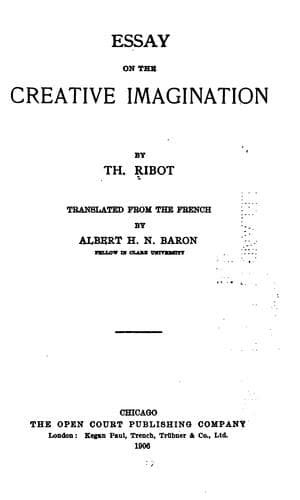
Essay on the Creative ImaginationRibot, Th. (Théodule)
Science
Essay on the Creative Imagination
Ribot, Th. (Théodule)
Creation (Literary, artistic, etc.); Imagination
To conclude: At this period the imagination is the master-faculty and
the highest form of intellectual development. It works in two
directions, one principal--it creates plays, invents romances, and
extends language; the other secondary--it contains a germ of thought and
ventures a fanciful explanation of the world which can not yet be
conceived according to abstract notions and laws.
FOOTNOTES:
[40] One will find a large number of examples in Sully's work,
_Studies of Childhood_, Chapter ii, entitled "The Age of
Imagination." Most of the observations given in the present chapter
have been borrowed from this author.
[41] Apropos of this subject compare especially the recent studies
by William James, _Varieties of Religious Experience_. (Tr.)
[42] Spinoza, _Ethics_, II, 49, _Scholium_; Hume, _Human
Understanding_, Part III, Section VII ff.; Dugald Stewart, _Elements
of the Philosophy of the Human Mind_, Vol. I, Ch. III; Taine, _On
Intelligence_, Part II.
[43] James, _The Will to Believe and Other Essays_, p. 10.
[44] Payot, _De la croyance_, 139 ff.
[45] B. Perez, _Les trois premieres annees de l'enfant_, p. 323.
[46] Sully, _op. cit._, pp. 59-61. Compayre, _L'evolution
intellectuelle et morale de l'enfant_, p. 145.
(Some time ago the writer was riding on a train, when the engine,
for some reason or other, began to slow up, jerking, puffing, almost
groaning, until it finally came to a full stop. The groaning
continued. A little girl of about three called to her mother,
"Too-too sick, too-too sick," and when finally the train started on
again, the child was overjoyed that "too-too" was well again. (Tr.))
[47] Sully, _op. cit._, p. 164.
CHAPTER III
PRIMITIVE MAN AND THE CREATION OF MYTHS
We come now to a unique period in the history of the development of the
imagination--its golden age. In primitive man, still confined in
savagery or just starting toward civilization, it reaches its full bloom
in the creation of myths; and we are rightly astonished that
psychologists, obstinately attached to esthetics, have neglected such an
important form of activity, one so rich in information concerning the
creative imagination. Where, indeed, find more favorable conditions for
knowing it?
Public-domain text, read in full here on John Shaqi.
Reviews
Reviews
No reviews yet
Be the first to share your thoughts on this work.
Join the Discussion
Join the discussion
Sign in to leave a comment or review.
Sign InorCreate an account