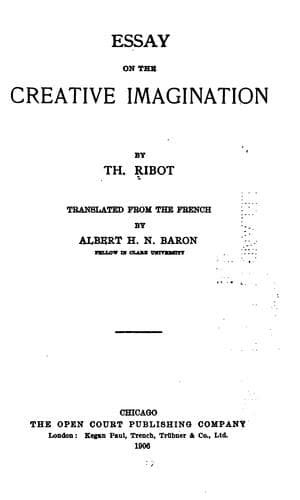
Essay on the Creative ImaginationRibot, Th. (Théodule)
Science
Essay on the Creative Imagination
Ribot, Th. (Théodule)
Creation (Literary, artistic, etc.); Imagination
b. In the genesis of myths, the second moment is that of fanciful
invention. Entities take form; they have a history and adventures: they
become the stuff for a romance. People of poor and dry imagination do
not reach the second period. Thus, the religion of the Romans peopled
the universe with an innumerable quantity of genii. No object, no act,
no detail, but had its own presiding genius. There was one for
germinating grain, for sprouting grain, for grain in flower, for
blighted grain; for the door, its hinges, its lock, etc. There was a
myriad of misty, formless entities. This is animism arrested at its
first stage; abstraction has killed imagination.
Who created those legends and tales of adventure constituting the
subject-matter of mythology? Probably inspired individuals, priests or
prophets. They came perhaps from dreams, hallucinations, insane
attacks--they are derived from several sources. Whatever their origin,
they are the work of imaginative minds _par excellence_ (we shall study
them later) who, confronted with any event whatever, must, because of
their nature, construct a romance.
Besides analogy, this imaginative creation has as its principal source
the associational form already described under the name "constellation."
We know that it is based on the fact that, in certain cases, the
arousing of an image-group is the result of a tendency prevailing at a
given instant over several that are possible. This operation has already
been expounded theoretically with individual examples in support.[55]
But in order to gauge its importance, we must see it act in large
masses. Myths allow us to do this. Ordinarily they have been studied in
their historical development according to their geographical
distribution or ethnic character. If we proceed otherwise, if we
consider only their content--i.e., the very few themes upon which the
human imagination has labored, such as celestial phenomena, terrestrial
disturbances, floods, the origin of the universe, of man, etc.--we are
surprised at the wonderful richness of variety. What diversity in the
solar myths, or those of creation, of fire, of water! These variations
are due to multiple causes, which have orientated the imagination now in
one direction, now in another. Let us mention the principal ones: Racial
characteristics--whether the imagination is clear or mobile, poor or
exuberant; the manner of living--totally savage, or on a level of
civilization; the physical environment--external nature cannot be
reflected in the brain of a Hindoo in the same way as in that of a
Scandinavian; and lastly, that assemblage of considerable and unexpected
causes grouped under the term "chance."
The variable combinations of these different factors, with the
predominance of one or the other, explain the multiplicity of the
imaginative conceptions of the world, in contrast to the unity and
simplicity of scientific conceptions.
II
Public-domain text, read in full here on John Shaqi.
Reviews
Reviews
No reviews yet
Be the first to share your thoughts on this work.
Elsewhere in the archive
Join the Discussion
Join the discussion
Sign in to leave a comment or review.
Sign InorCreate an account