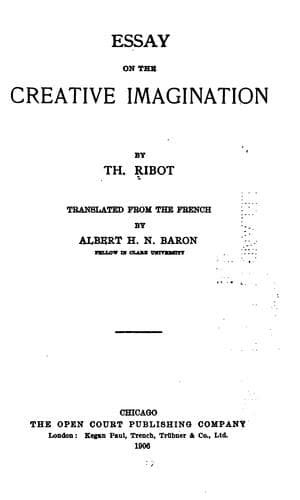
Essay on the Creative ImaginationRibot, Th. (Théodule)
Science
Essay on the Creative Imagination
Ribot, Th. (Théodule)
Creation (Literary, artistic, etc.); Imagination
b. In addition to the explanatory myths, there are those having no claim
to be in this class, although they have perhaps been originally
suggested by some phenomenon of animate or inanimate nature. They are
much less numerous than the others, since they do not answer multiple
necessities of life. Such are the epic or heroic stories, popular tales,
romances (which are found as early as ancient Egypt): it is the first
appearance of that form of esthetic activity destined later to become
literature. Here, the mythic activity suffers only a superficial
metamorphosis--the essence is not changed. Literature is mythology
transformed and adapted to the variable conditions of civilization. If
this statement appear doubtful or disrespectful, we should note the
following.
Historically, from myths wherein there figure at first only divine
personages, there arise the epics of the Hindoos, Greeks, Scandinavians,
etc., in which the gods and heroes are confounded, live in the same
world, on a level. Little by little the divine character is rubbed out;
the myth approaches the ordinary conditions of human life, until it
becomes the romantic novel, and finally the realistic story.
Psychologically, the imaginative work that has at first created the gods
and superior beings before whom man bows because he has unconsciously
produced them, becomes more and more humanized as it becomes conscious;
but it cannot cease being a projection of the feelings, ideas, and
nature of man into the fictitious beings upon whom the belief of their
creator and of his hearers confers an illusory and fleeting existence.
The gods have become puppets whose master man feels himself, and whom he
treats as he likes. Throughout the manifold techniques, esthetics,
documentary collections, reproductions of the social life, the creative
activity of the earliest time remains at bottom unchanged. Literature is
a decadent and rationalized mythology.
III
Does the mythic activity of ancient times still exist among civilized
peoples, unmodified as in literary creation, but in its pure form, as a
non-individual, collective, anonymous, unconscious, work? Yes; as the
popular imagination, when creating legends. In passing from natural
phenomena to historic events and persons, the constructive imagination
takes a slightly different position which we may characterize thus:
legend is to myth what illusion is to hallucination.
Public-domain text, read in full here on John Shaqi.
Reviews
Reviews
No reviews yet
Be the first to share your thoughts on this work.
Elsewhere in the archive
Join the Discussion
Join the discussion
Sign in to leave a comment or review.
Sign InorCreate an account