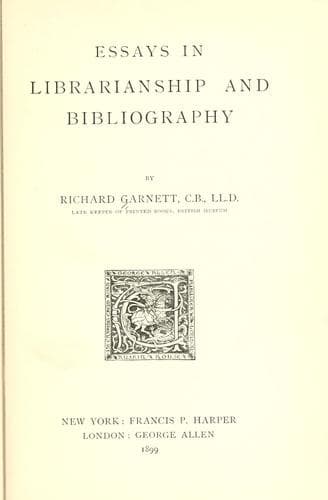
Essays in Librarianship and BibliographyGarnett, Richard
Science
Essays in Librarianship and Bibliography
Garnett, Richard
Bibliography -- Methodology; British Museum; Library science
organisation in which, the salaries of the staff being defrayed as in
other departments by the State, there will be no expense to be
considered beyond the mere cost of chemicals, there need be no limit to
the reproduction of its treasures. Sculptures, coins, and prints can be
disseminated over every hamlet; manuscripts can be multiplied
indefinitely and exchanged with foreign libraries for corresponding
donations, illustrative of English history and antiquities; foreign and
country scholars will be able to consult rare books and unique
manuscripts without leaving their arm-chairs; and, above all, the
scattered portions of the nearest approach the world will have made to a
Universal Catalogue may be brought together, digested into alphabetical
order, and, reproduced in facsimile by this beautiful art—fit mate of
Printing in that she too preserves what would else perish, and brings
light into many a dark place—be given to the world.[86:1]
FOOTNOTES:
[67:1] Read before the Library Association, Cambridge, Sept. 1882.
[86:1] This forecast of the service which photography might render to
library catalogues would seem to have been inspired by the very spirit
of prophecy. See, in the _American Library Journal_ for March 1899,
an account by A. J. Rudolph of the success of the Newberry Library,
Chicago, "in printing a catalogue of the accessions accumulated in
the British Museum since 1880 to date, in one general alphabet by the
so-called blue-print process, a method of photo-printing." If the
Newberry Library can do this, the British Museum ought to be able
to incorporate its accession-titles with the general catalogue, and
reissue the latter from time to time, as frequently recommended in
this volume, and in a remarkable article in the _Quarterly Review_ for
October 1898.
THE PAST, PRESENT, AND FUTURE OF THE BRITISH MUSEUM CATALOGUE[87:1]
The present and the future of the British Museum Catalogue are so much
more important than its past, that this part of our subject must be
touched with brevity. Resisting, therefore, every temptation to
expatiate upon the desert of ancient cataloguers, further than by the
observation that Moses and Homer were of the brotherhood, we begin with
June 21, 1759, when the Trustees of the British Museum, which
institution had been opened to the public in the preceding January,
recorded the following remarkable minute:—
"The Committee think proper to add that the requiring the attendance of
the officers during the whole six hours that the Museum is kept open is
not a wanton or useless piece of severity, as the two vacant hours (if
it is not thought a burden upon the officers) might very usefully be
employed by them in better ranging the several collections; especially
in the Department of Manuscripts, and preparing catalogues for
publication, which last the Committee think so necessary a work that
till it is performed the several collections can be but imperfectly
useful to the public."
Public-domain text, read in full here on John Shaqi.
Reviews
Reviews
No reviews yet
Be the first to share your thoughts on this work.
Join the Discussion
Join the discussion
Sign in to leave a comment or review.
Sign InorCreate an account