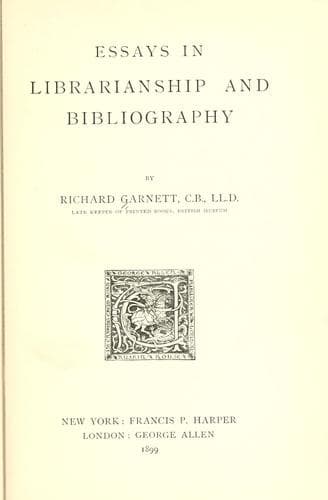
Essays in Librarianship and BibliographyGarnett, Richard
Science
Essays in Librarianship and Bibliography
Garnett, Richard
Bibliography -- Methodology; British Museum; Library science
From this we learn that the officers of the Museum had at that primitive
period of its history but two hours to spare from conducting visitors
over the building; that the Committee rather expected to be censured for
requiring any other duty from them; and that, though the Trustees
themselves thought catalogues useful and even necessary, there were
those who deemed otherwise. The Museum Library dispensed with a printed
catalogue until 1787, when one was issued in two volumes folio, the work
of three persons, two-thirds of whose time was otherwise occupied. It
would therefore be unjust as well as unbecoming to criticise its many
defects with asperity. The compilers seem to have adopted as their
principle that the cataloguer who looks beyond the title-page is lost.
They therefore enter "The London Prodigal" and "Mucedorus" under
Shakespeare with no impertinent scepticism as to the authorship;
bewilder themselves with no nice distinctions between the William Bedloe
who wrote against Mahometanism in 1615, and the William Bedloe who swore
away the lives of Roman Catholics in 1680; and achieve their crowning
glory by cataloguing the thirty-three thousand Civil War tracts at a
stroke under "Anglia" as "a large collection of pamphlets." If they had
tried to do more they would probably have done nothing. Their list,
meagre in every sense, and at the present day less interesting for what
it contains than for what it does not contain, served for twenty years,
when a beginning was made towards superseding it by the more elaborate
performance of Sir Henry Ellis and Mr. Baber. This catalogue, commenced
in 1807, was completed in 1819. The portion executed by Sir Henry Ellis
has been severely criticised. It was certainly unfortunate that _pastor
paganus_ should have been treated as the equivalent of _sacerdos
ethnicus_, and Emanuel Prince of Peace mistaken for Emanuel King of
Portugal. Its virtue, however, of portable brevity, has rendered it so
useful a substitute for its colossal successor on those not unfrequent
occasions when the wood could not be seen for the trees, that those thus
beholden to it will be little inclined to deal hardly with its notorious
errors and deficiencies.
Public-domain text, read in full here on John Shaqi.
Reviews
Reviews
No reviews yet
Be the first to share your thoughts on this work.
Join the Discussion
Join the discussion
Sign in to leave a comment or review.
Sign InorCreate an account