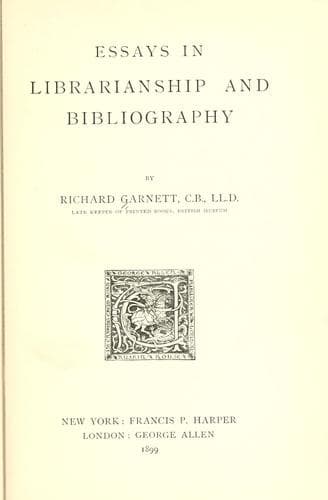
Essays in Librarianship and BibliographyGarnett, Richard
Science
Essays in Librarianship and Bibliography
Garnett, Richard
Bibliography -- Methodology; British Museum; Library science
Ellis and Baber's catalogue had scarcely been completed ere the need of
a new one began to be felt, partly on account of the magnificent
donation of the 60,000 volumes and 20,000 pamphlets of the King's
Library. Notions of classification were then in the ascendant, and in
1826 the Rev. T. Hartwell Horne, a bibliographer famed for strict method
and plodding industry, was engaged as a temporary assistant to carry
them out; together with Mr. (afterwards Sir Frederic) Madden, Mr. Tidd
Pratt, and other persons of literary ability. Seldom has an undertaking
so extensive left so little trace behind it. Mr. Horne's assistants
ascended to higher spheres, or evaporated entirely, and when called upon
in 1834 to report the progress of the previous year, he could only state
that he had personally arranged the classes of "chemical and medical
philosophy"; the latter, indeed, under twenty divisions, with such
subdivisions as "Treatises on Plethora," "Treatises on the Vis
Medicatrix Naturæ," "Use of Flagellation, Friction and Philtres." The
list may be commended to the study of those who think classification a
simple matter, or a classed catalogue serviceable otherwise than as an
index to an alphabetical one. Seven thousand pounds had been expended
upon the simple sorting of titles, a task merely preliminary to that of
printing them, which might be considered as at least nearly half done,
if only the influx of new titles could be stopped, which was impossible.
The Trustees wisely determined to throw no more good money after bad;
and the episode of classification came to an end in July 1834. Mr.
Baber, Keeper of Printed Books, had already proposed a plan for a new
printed catalogue, to be executed under the superintendence of a single
competent person, a description denoting Panizzi, then "an extra
assistant librarian." This scheme was set aside in favour of a far
inferior plan, by which the execution of the catalogue was entrusted to
four persons of very unequal degrees of capacity, virtually independent
of each other. The consequence was that the little they did required to
be done again. Panizzi became head of the Printed Book Department in
1837, and the long discussions which ensued between him and the Trustees
resulted eventually in the ninety-one famous rules which have since
formed the foundation of scientific cataloguing drawn up by him with
the assistance of Messrs. Winter Jones, Watts, Parry, and Edwards. Their
number has afforded a theme for much good-natured and ill-natured
satire; on examination, however, it will be found that a third of them
relate merely to arrangement, and that the remainder are far from
providing for all conceivable cases. It may be granted that their
complexity was incompatible with the Trustees' desire to produce a
printed catalogue at an early date, a desire in which their officer was
far from participating. The Trustees defeated their own object, partly
by allowing the catalogue to be commenced on so extensive a scale;
Public-domain text, read in full here on John Shaqi.
Reviews
Reviews
No reviews yet
Be the first to share your thoughts on this work.
Join the Discussion
Join the discussion
Sign in to leave a comment or review.
Sign InorCreate an account