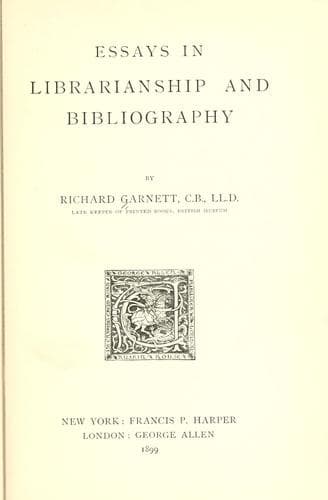
Essays in Librarianship and BibliographyGarnett, Richard
Science
Essays in Librarianship and Bibliography
Garnett, Richard
Bibliography -- Methodology; British Museum; Library science
Panizzi wanted a catalogue: he had framed the rules for it with
completeness and precision never imagined before his time, but he was
entirely averse to the catalogue being printed. In his report of
November 17, 1837, he declared it unreasonable to expect that the public
should spend the enormous sum that the printing of a catalogue of the
whole of such a library requires, to suit the convenience of a small
portion of the community. There was much weight in the argument, and the
propounder of it could not foresee that he would himself in the long run
overthrow it by the extraordinary development he was destined to impart
to the library, and by consequence to the catalogue. When, eight years
after the date of the report just quoted, Panizzi's persevering efforts
obtained an annual grant of £10,000 to remedy the deficiencies of the
library, he started the catalogue on a road whose inevitable goal was
print. Library and catalogue increasing _pari passu_, it became
abundantly clear that recourse must some day be had to print for the
mere sake of reducing the bulk of the latter. This consummation was
accelerated by another of Panizzi's great measures—the introduction, at
the independent and almost simultaneous suggestion of Mr. Wilson Croker
and the late Mr. Roy, of the Library, of the system of keeping up the
catalogue by slips pasted on the leaf, and therefore easily removable,
thus preventing the disturbance of alphabetical order. As this gave
three thicknesses to the leaf, and the slips were at first pasted widely
apart, and were not, moreover, transcribed with any special regard to
economy of space, the hundred and fifty volumes placed in the Reading
Room in 1850 had swollen to fifteen times that number by 1875. This
development was attended by another unforeseen consequence; it became
actually more expensive to transcribe the catalogue than to print it.
The number of transcribers employed to copy titles, of incorporators
required to assign these to their proper places, of binders' men to
perform the manual work, the incessant shifting and relaying, inserting
new leaves and dividing and rebinding old volumes, were attended by
financial results which frequently elicited communications from the
Treasury. One of these happened to arrive in 1875, shortly after the
writer of these pages had become Superintendent of the Reading Room.
Being now in a position to report upon the subject, he pointed out what
had long been exceedingly plain to him, that the space available for the
accommodation of the catalogue was all but exhausted, and that on this
ground alone it would be imperative to reduce its bulk by printing at
least a portion of it. In 1878 his representations were renewed, this
time with great encouragement from Sir Charles Newton, then acting as
Principal Librarian, but nothing decisive was done until the accession
of the late Principal Librarian, Mr. E. A. Bond, in the autumn of the
same year. Mr.
Public-domain text, read in full here on John Shaqi.
Reviews
Reviews
No reviews yet
Be the first to share your thoughts on this work.
Join the Discussion
Join the discussion
Sign in to leave a comment or review.
Sign InorCreate an account