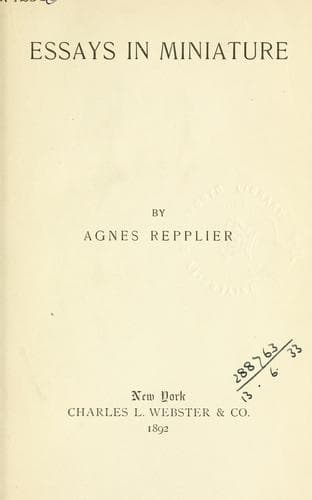
American essays -- 19th century; Literature -- History and criticism
American publishers, however, are as delighted to offer their readers a
new cover as a new story, and it is occasionally interesting to follow
a magazine through all its outer vicissitudes. There was a time when
_Saint Nicholas_ behaved like Harlequin in the pantomime, slipping into
fresh costumes with bewildering alertness and rapidity. _The Century_
has adopted a plan eminently fitted to confuse and distress people who
are in love with the familiar, and who have barely time to accustom
themselves to one of the picturesque young women on its cover, before
they are confronted with another. The only engaging and comforting thing
about these rival damsels is their strong family resemblance. They are
like the fair daughters of Doris, with faces “neither the same nor
different, but as those of sisters should be.” The wanton alterations
in _Harper’s Magazine_ are none the less heart-breaking for being so
trivial. As well rob us of an old friend altogether as tamper with his
absolute integrity. No one can claim for _Harper_ that its time-honored
cover has any rare artistic quality, any of that subtle and far-reaching
suggestiveness that we prize so wearily to-day. On the contrary, its
little boys scattering roses into nowhere, and its preposterous child
blowing soap bubbles on a globe belong distinctly to the cheerful school
of Philistia, and are not burdened with meanings of any kind. That makes
them so refreshing to our eyes; and besides I have always regarded them
with sincere affection, because of the pleasure they afforded me in
infancy. It was one of the unwritten laws of our nursery that, when a
new magazine arrived, the old one passed into our possession. We painted
all the pictures with water colors, and we cut out the little figures on
the cover for paper dolls. Not the child straddling over the globe! It
was impossible to make anything out of him, owing to his uncomfortable
position. But the lads in tunics we thought extremely pretty, especially
the one in the right-hand corner, whose head was as round as a bullet.
The left-hand boy had a slightly flattened skull, which destroyed his
perfect symmetry, though we occasionally remedied this defect by leaving
him a small portion of his basket, and pretending it was hair. Now,
alas! though the children still mount guard on their flower-wreathed
pedestals, and still scatter their roses in the air, some unkind hand has
wrought radical changes in their aspect. They have grown bigger, stouter,
and their decent little tunics, so nicely drawn up over one shoulder,
have been replaced by those absurd floating draperies which form the
conventional attire of seraphs and sea nymphs all the world over. Never
was there such an unhappy transformation. It is true that on the old
cover of _Bentley’s Magazine_—if we may trust the minute picture of it
on the face of _Littell_—the little figures with baskets were clad, or
unclad, in these same airy rags. But this fact does not reconcile me at
all.
Public-domain text, read in full here on John Shaqi.
Reviews
Reviews
No reviews yet
Be the first to share your thoughts on this work.
Elsewhere in the archive
Join the Discussion
Join the discussion
Sign in to leave a comment or review.
Sign InorCreate an account