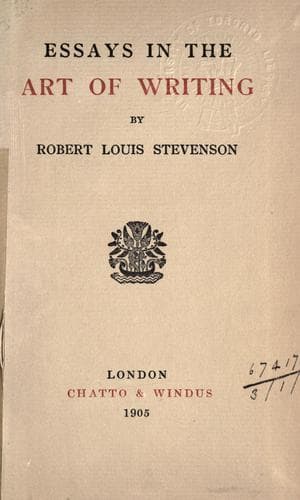
Essays in the Art of WritingStevenson, Robert Louis
History
Essays in the Art of Writing
Stevenson, Robert Louis
Authorship; Literature -- History and criticism; Stevenson, Robert Louis, 1850-1894 -- Authorship
It is, then, first of all, at this initial and decisive moment when
execution is begun, and thenceforth only in a less degree, that the ideal
and the real do indeed, like good and evil angels, contend for the
direction of the work. Marble, paint, and language, the pen, the needle,
and the brush, all have their grossnesses, their ineffable impotences,
their hours, if I may so express myself, of insubordination. It is the
work and it is a great part of the delight of any artist to contend with
these unruly tools, and now by brute energy, now by witty expedient, to
drive and coax them to effect his will. Given these means, so laughably
inadequate, and given the interest, the intensity, and the multiplicity
of the actual sensation whose effect he is to render with their aid, the
artist has one main and necessary resource which he must, in every case
and upon any theory, employ. He must, that is, suppress much and omit
more. He must omit what is tedious or irrelevant, and suppress what is
tedious and necessary. But such facts as, in regard to the main design,
subserve a variety of purposes, he will perforce and eagerly retain. And
it is the mark of the very highest order of creative art to be woven
exclusively of such. There, any fact that is registered is contrived a
double or a treble debt to pay, and is at once an ornament in its place,
and a pillar in the main design. Nothing would find room in such a
picture that did not serve, at once, to complete the composition, to
accentuate the scheme of colour, to distinguish the planes of distance,
and to strike the note of the selected sentiment; nothing would be
allowed in such a story that did not, at the same time, expedite the
progress of the fable, build up the characters, and strike home the moral
or the philosophical design. But this is unattainable. As a rule, so
far from building the fabric of our works exclusively with these, we are
thrown into a rapture if we think we can muster a dozen or a score of
them, to be the plums of our confection. And hence, in order that the
canvas may be filled or the story proceed from point to point, other
details must be admitted. They must be admitted, alas! upon a doubtful
title; many without marriage robes. Thus any work of art, as it proceeds
towards completion, too often—I had almost written always—loses in force
and poignancy of main design. Our little air is swamped and dwarfed
among hardly relevant orchestration; our little passionate story drowns
in a deep sea of descriptive eloquence or slipshod talk.
Public-domain text, read in full here on John Shaqi.
Reviews
Reviews
No reviews yet
Be the first to share your thoughts on this work.
Join the Discussion
Join the discussion
Sign in to leave a comment or review.
Sign InorCreate an account