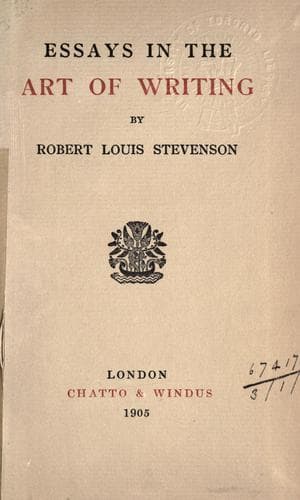
Essays in the Art of WritingStevenson, Robert Louis
History
Essays in the Art of Writing
Stevenson, Robert Louis
Authorship; Literature -- History and criticism; Stevenson, Robert Louis, 1850-1894 -- Authorship
I have said the map was the most of the plot. I might almost say it was
the whole. A few reminiscences of Poe, Defoe, and Washington Irving, a
copy of Johnson’s _Buccaneers_, the name of the Dead Man’s Chest from
Kingsley’s _At Last_, some recollections of canoeing on the high seas,
and the map itself, with its infinite, eloquent suggestion, made up the
whole of my materials. It is, perhaps, not often that a map figures so
largely in a tale, yet it is always important. The author must know his
countryside, whether real or imaginary, like his hand; the distances, the
points of the compass, the place of the sun’s rising, the behaviour of
the moon, should all be beyond cavil. And how troublesome the moon is!
I have come to grief over the moon in _Prince Otto_, and so soon as that
was pointed out to me, adopted a precaution which I recommend to other
men—I never write now without an almanack. With an almanack, and the map
of the country, and the plan of every house, either actually plotted on
paper or already and immediately apprehended in the mind, a man may hope
to avoid some of the grossest possible blunders. With the map before
him, he will scarce allow the sun to set in the east, as it does in _The
Antiquary_. With the almanack at hand, he will scarce allow two
horsemen, journeying on the most urgent affair, to employ six days, from
three of the Monday morning till late in the Saturday night, upon a
journey of, say, ninety or a hundred miles, and before the week is out,
and still on the same nags, to cover fifty in one day, as may be read at
length in the inimitable novel of _Rob Roy_. And it is certainly well,
though far from necessary, to avoid such ‘croppers.’ But it is my
contention—my superstition, if you like—that who is faithful to his map,
and consults it, and draws from it his inspiration, daily and hourly,
gains positive support, and not mere negative immunity from accident.
The tale has a root there; it grows in that soil; it has a spine of its
own behind the words. Better if the country be real, and he has walked
every foot of it and knows every milestone. But even with imaginary
places, he will do well in the beginning to provide a map; as he studies
it, relations will appear that he had not thought upon; he will discover
obvious, though unsuspected, short-cuts and footprints for his
messengers; and even when a map is not all the plot, as it was in
_Treasure Island_, it will be found to be a mine of suggestion.
THE GENESIS OF ‘THE MASTER OF BALLANTRAE’
Public-domain text, read in full here on John Shaqi.
Reviews
Reviews
No reviews yet
Be the first to share your thoughts on this work.
Elsewhere in the archive
Join the Discussion
Join the discussion
Sign in to leave a comment or review.
Sign InorCreate an account