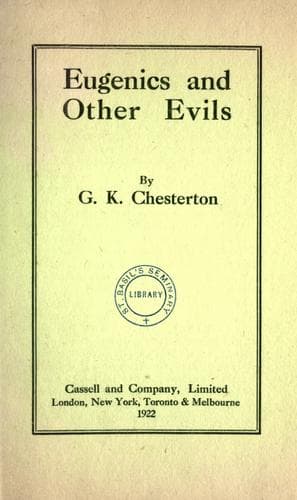
Eugenics and Other EvilsChesterton, G. K. (Gilbert Keith)
Philosophy
Eugenics and Other Evils
Chesterton, G. K. (Gilbert Keith)
Eugenics
I think it is no more than justice to him to say that the knowledge,
where it has come to him, has come to him slowly; and I think it came
(as most things of common sense come) rather vaguely and as in a
vision--that is, by the mere look of things. The old Cobdenite
employer was quite within his rights in arguing that earth is not
heaven, that the best obtainable arrangement might contain many
necessary evils; and that Liverpool and Belfast might be growing more
prosperous as a whole in spite of pathetic things that might be seen
there. But I simply do not believe he has been able to look at
Liverpool and Belfast and continue to think this: that is why he has
turned himself into a sham country gentleman. Earth is not heaven, but
the nearest we can get to heaven ought not to _look_ like hell; and
Liverpool and Belfast look like hell, whether they are or not. Such
cities might be growing prosperous as a whole, though a few citizens
were more miserable. But it was more and more broadly apparent that it
was exactly and precisely _as a whole_ that they were not growing more
prosperous, but only the few citizens who were growing more prosperous
by their increasing misery. You could not say a country was becoming a
white man's country when there were more and more black men in it
every day. You could not say a community was more and more masculine
when it was producing more and more women. Nor can you say that a city
is growing richer and richer when more and more of its inhabitants are
very poor men. There might be a false agitation founded on the pathos
of individual cases in a community pretty normal in bulk. But the fact
is that no one can take a cab across Liverpool without having a quite
complete and unified impression that the pathos is not a pathos of
individual cases, but a pathos in bulk. People talk of the Celtic
sadness; but there are very few things in Ireland that look so sad as
the Irishman in Liverpool. The desolation of Tara is cheery compared
with the desolation of Belfast. I recommend Mr. Yeats and his mournful
friends to turn their attention to the pathos of Belfast. I think if
they hung up the harp that once in Lord Furness's factory, there would
be a chance of another string breaking.
Public-domain text, read in full here on John Shaqi.
Reviews
Reviews
No reviews yet
Be the first to share your thoughts on this work.
Elsewhere in the archive
Join the Discussion
Join the discussion
Sign in to leave a comment or review.
Sign InorCreate an account