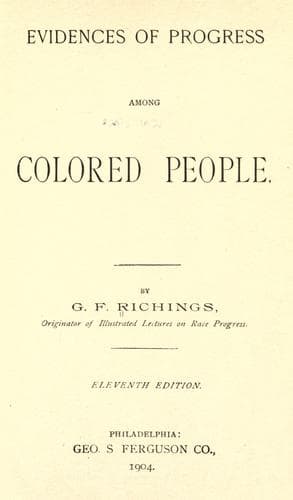
Evidences of Progress Among Colored PeopleRichings, G. F.
History
Evidences of Progress Among Colored People
Richings, G. F.
African Americans
I desire to call the reader's attention to the fact that all of the A.
M. E. Schools are supported entirely by the colored people. In this
regard they are unlike other denominational institutions.
WILBERFORCE UNIVERSITY.
It is a beautiful coincidence, full of historic value, that appears
in the planting of two institutions in Greene county, Ohio, some
four miles apart. Between them runs a highway over which passed,
some thirty-five years ago, that mysterious line known in history as
the Underground Railroad. It was while the slave was yet hastening
his flight from the tobacco patches, the cotton fields, the sugar
plantations of the Central South to the sterner clime of England's
Colony, cold yet free, that Wilberforce University rose, right beside
his perilous path, to offer freedom of mind and heart to him who dared
remain. The war came with its carnage and death. Twenty years later
Ohio built a home where the orphan of the soldier who died to free the
slave might be succored in the years of its helplessness. In sight of
each other and on opposite sides of the fugitive's path to liberty,
stand these historic monuments, the results of a civilization that is
the glory of the century.
[Illustration: WILBERFORCE UNIVERSITY.]
Wilberforce University was organized in 1856 by the M. E. Church. Its
object was higher educational facilities for colored youth. In its
first Board of twenty-four Trustees was Hon. Salmon P. Chase, then
governor of Ohio, and the fugitive slave's powerful advocate; also Rev.
Richard S. Rust and Bishop Daniel A. Payne. Its first active president
was Dr. R. S. Rust, and its students were largely "the natural children
of Southern and Southwestern planters." On the beautiful premises, for
which Nature has done so much, with its sparkling mineral springs, its
varying landscape, its superb repose, the young institution grew and
flourished. But the dark days of civil strife closed in upon it and its
patronage from the South ceased, its operations were suspended.
[Illustration: BISHOP D. A. PAYNE, D. D., LL. D.,
_First President of Wilberforce_.]
While the war was still in progress, the future, full of misgivings,
without a dollar and alone, on the night of the 10th of March, 1863,
Bishop Payne purchased the college property for $10,000. He at once
associated with himself Rev. James A. Shorter, afterward Bishop, and
Prof. J. G. Mitchell, now Dean of Payne Theological Seminary. An act
of incorporation was duly taken out, with the broad principle embodied
in it that "there shall never be any distinction among the trustees,
faculty or students on account of race, color or creed."
Public-domain text, read in full here on John Shaqi.
Reviews
Reviews
No reviews yet
Be the first to share your thoughts on this work.
Join the Discussion
Join the discussion
Sign in to leave a comment or review.
Sign InorCreate an account