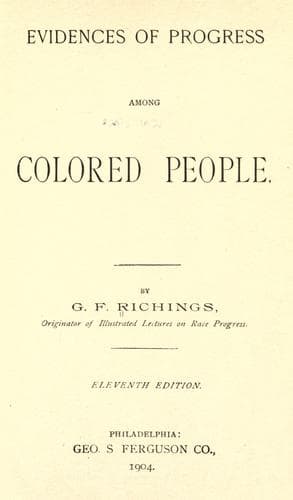
Evidences of Progress Among Colored People — John Shaqi
Evidences of Progress Among Colored PeopleRichings, G. F.
History
Evidences of Progress Among Colored People
Richings, G. F.
African Americans
The financial obligations which Bishop Payne had assumed were being
promptly met through his indefatigable efforts, and everything
indicated a prosperous future, when, on the 14th of April, 1865, and by
the hand of incendiaries, the beautiful edifice went up in flame and
smoke. That night Lincoln laid his life on Freedom's Altar. Undismayed,
President Payne began the labor of reconstruction. A four-story brick
building was commenced on the original site. Congress was importuned,
and through the influence of Senators John Sherman, Charles Sumner
and others, $28,000 was appropriated to complete and equip the work.
The consecrated efforts of the Founder of Wilberforce University were
fruitful in other directions. Through his influence, the society for
the promotion of Collegiate and Theological education at the west made
appropriations from its funds, of $1,800 per annum for two years. The
American Unitarian Association supported a lecture course from 1868 to
1875 at an outlay of $6,000. The will of Chief Justice Salmon P. Chase
contained as its first bequest, $10,000 for Wilberforce University, and
the executors of the Avery estate in Allegheny City added $10,000 to
its endowment.
For thirteen years Bishop Payne presided over the affairs of the
University. He called to his aid such instructors as Dr. Wm. Kent,
of England, Prof. T. E. Sullot, of Edinburgh, Scotland, Dr. J. G.
Mitchell, of Oberlin, Prof. W. B. Adams, of Amherst, Prof. B. K.
Sampson, of Oberlin, and Prof. J. P. Shorter, of Wilberforce, Ohio.
Among the ladies who rendered valuable service were Miss Esther T.
Maltby and Miss Sarah Jane Woodson, of Oberlin, Mrs. Alice M. Adams, of
Holyoke, and Miss Mary McBride, of Oswego.
From under Bishop Payne's hand went out such graduates as Dr. J. T.
Jenifer, Dr. T. H. Jackson, Prof. J. P. Shorter, Bishop B. F. Lee, Dr.
J. W. Beckett, President S. T. Mitchell, Miss Hallie Q. Brown, the
Misses Copeland and others of large acquirements and wide influence,
known over the continent. In the undergraduate column were Bishop Cain,
Bishop Salter, Dr. Wm. Hunter, Hon. C. L. Maxwell, Poet A. A. Whitman
and others. President Payne left his impress on every line of college
development. He organized the Trinity Church, the Society of Inquiry on
Missions and the Women's College Aid Society.
In the summer of 1879 his earnest endeavors placed in position our most
valuable teaching auxiliary, the Payne Museum, built by Prof. Henry
A. Ward, of Rochester, and illustrating the various departments of
Natural Science. The Museum is worth $2,000. Bishop Payne resigned the
presidency in 1876 and it was in the administration of his successor
that this important acquisition was made.
[Illustration: REV. B. F. LEE, D. D.]
Public-domain text, read in full here on John Shaqi.
Reviews
Reviews
No reviews yet
Be the first to share your thoughts on this work.
Join the Discussion
Join the discussion
Sign in to leave a comment or review.
Sign InorCreate an account